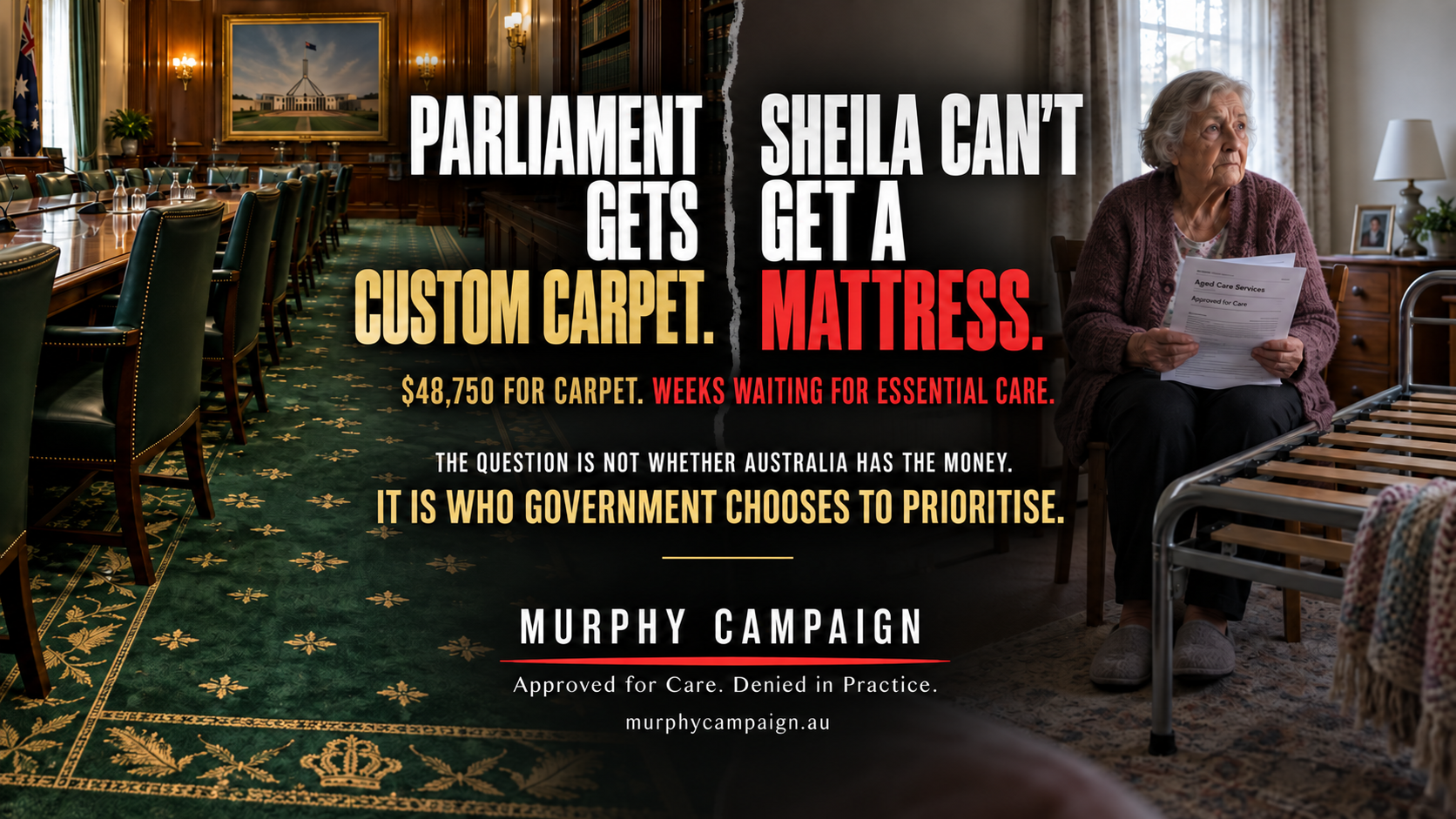
Priority campaign evidence · 14 September 2026

Approved for care. Still waiting. Still paying the price.

The latest Murphy Campaign evidence puts preventable deaths, hospital delay, financial hardship and blocked democratic communication at the front of the national aged-care debate.

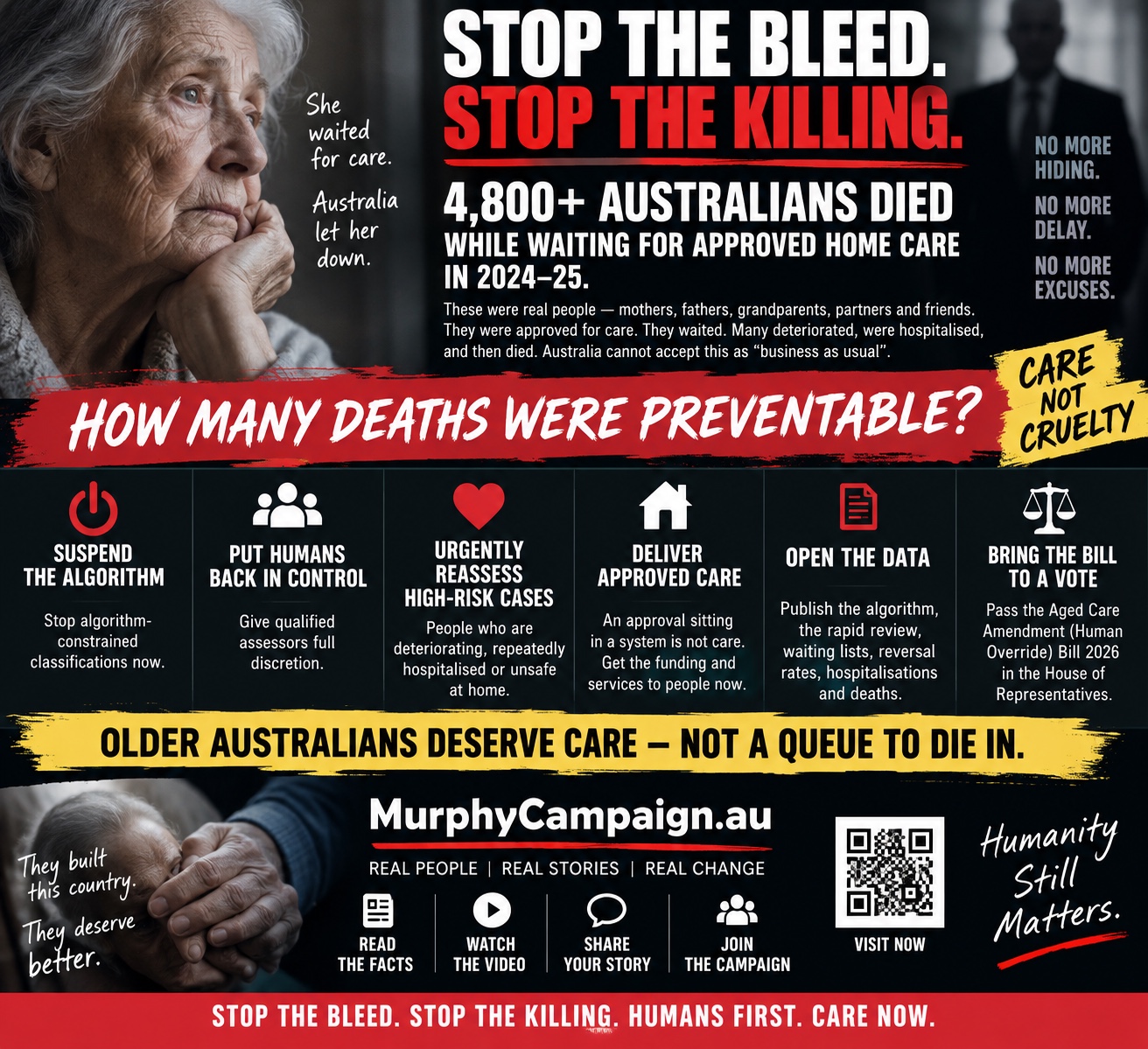
Stop the Bleed, Stop the Killing campaign poster reporting more than 4,800 Australians died while waiting for approved home care in 2024–25

Urgent national action

Stop the Bleed. Stop the Killing.

More than 4,800 Australians died while waiting for approved home care in 2024–25. They were assessed and approved, yet care did not arrive in time. The central question is unavoidable: how many deaths were preventable?

The Murphy Campaign calls for immediate delivery of approved care, urgent reassessment of high-risk people, publication of deaths and hospitalisations while waiting, suspension of algorithm-constrained classifications, and a legislated human clinical override.

Older Australians deserve care—not a queue to die in.

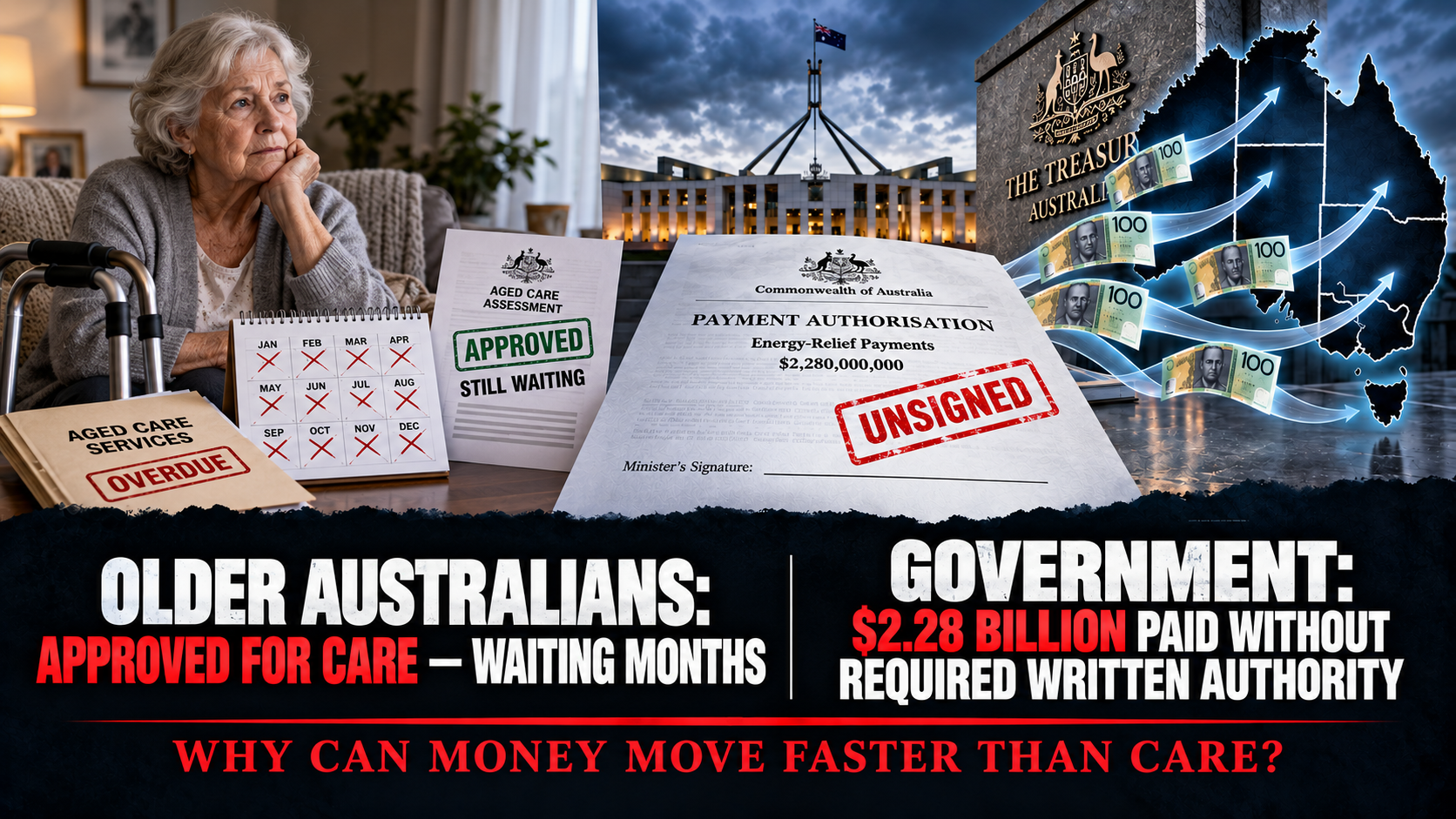
They Can't Handle the Truth poster documenting 159 blocked government email addresses

DEMOCRATIC ACCESS

When public offices block the public

Campaign distribution records show 159 government addresses rejected messages—133 NSW parliamentary addresses and 26 Northern Territory addresses. Constituents must have a reliable route to contact their elected representatives about older Australians being left without care.

A functioning democracy cannot place citizen evidence behind a firewall.

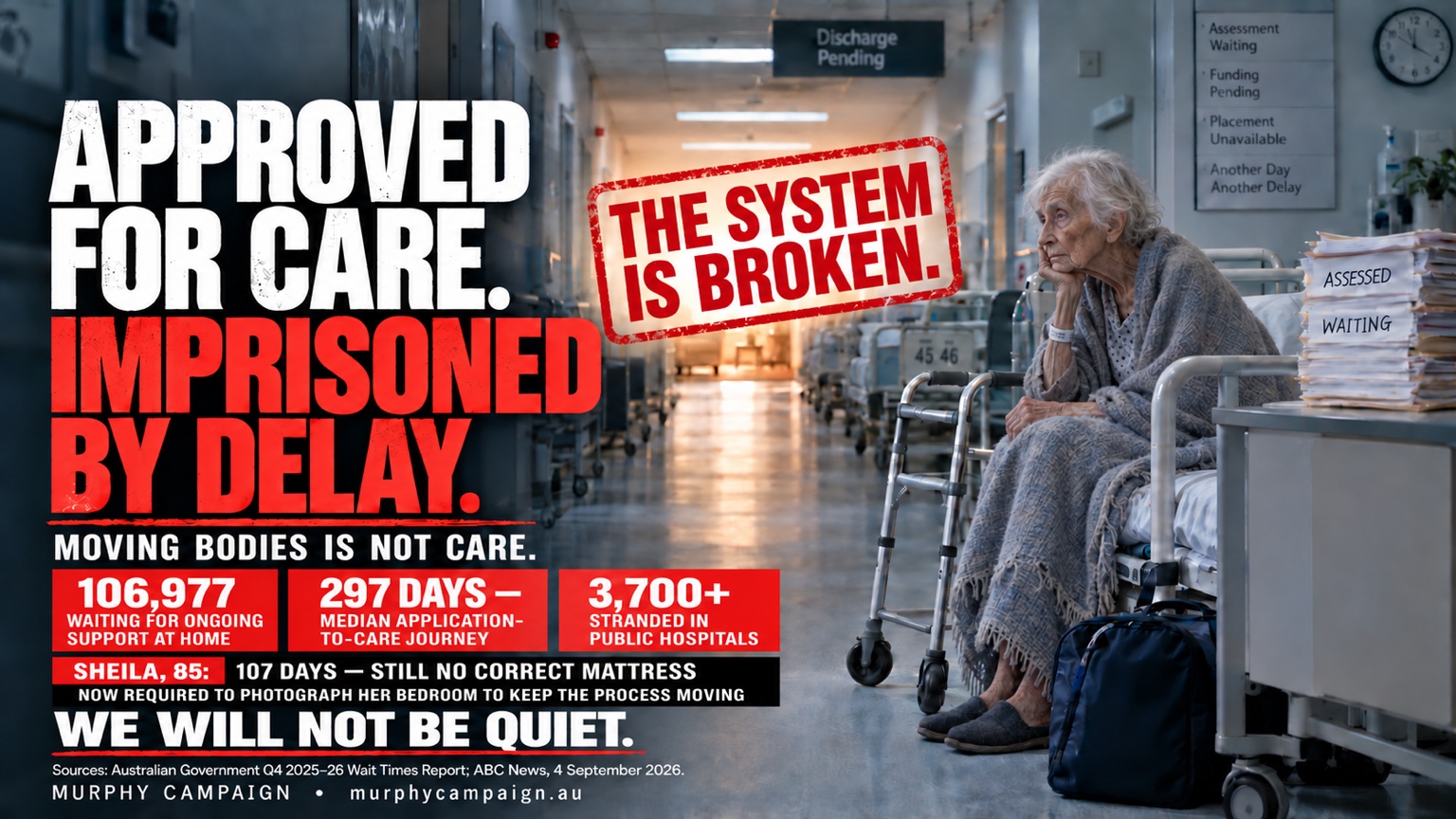
Approved for Care, Imprisoned by Delay poster showing aged-care waiting figures and hospital delay

SYSTEM FAILURE

Approved for care. Imprisoned by delay.

At 30 June 2026, 106,977 people were waiting for ongoing Support at Home services. The reported median application-to-care journey was 297 days, while thousands of medically ready patients remained stranded in public hospitals awaiting suitable support or placement.

Moving people between queues is not delivering care.

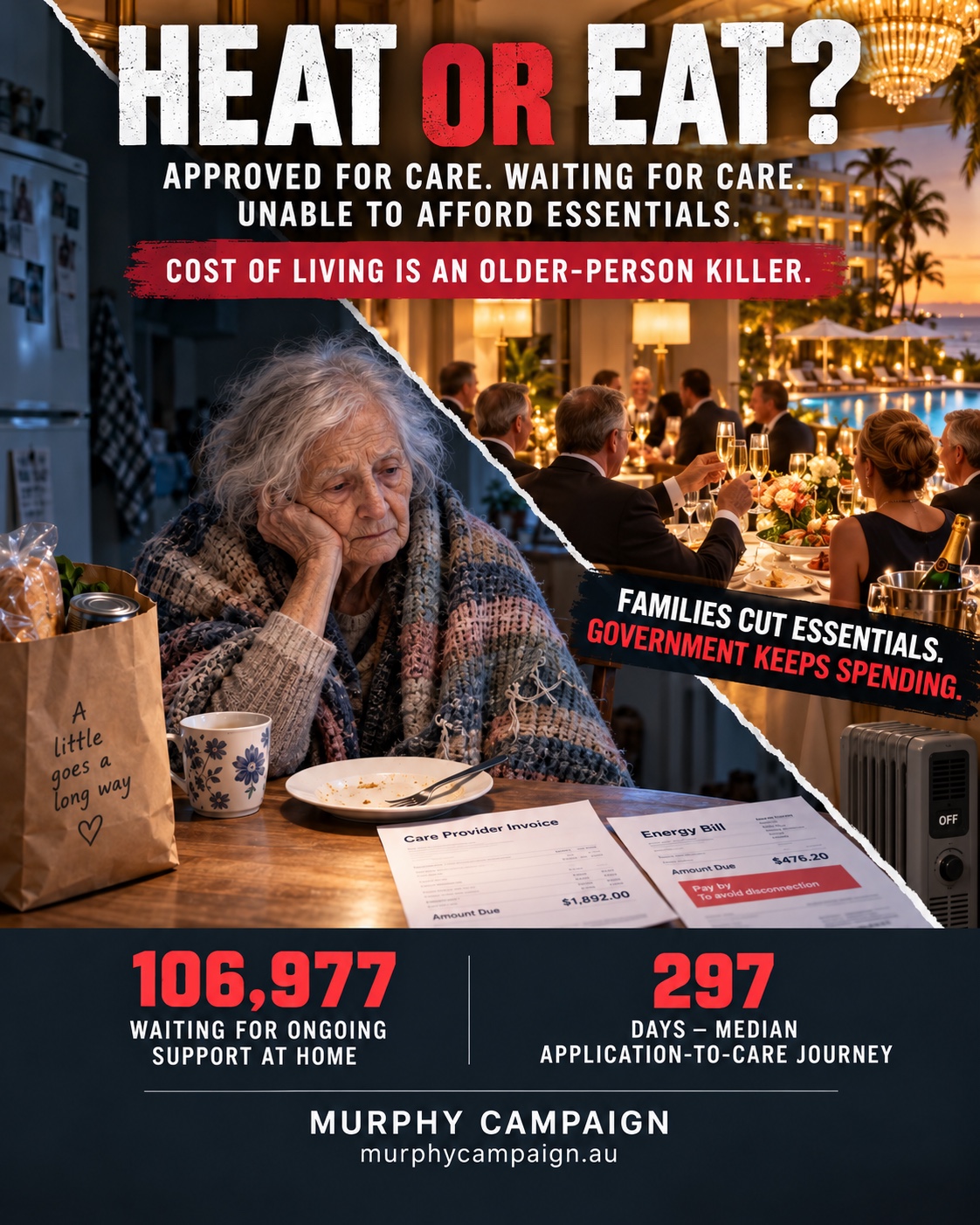
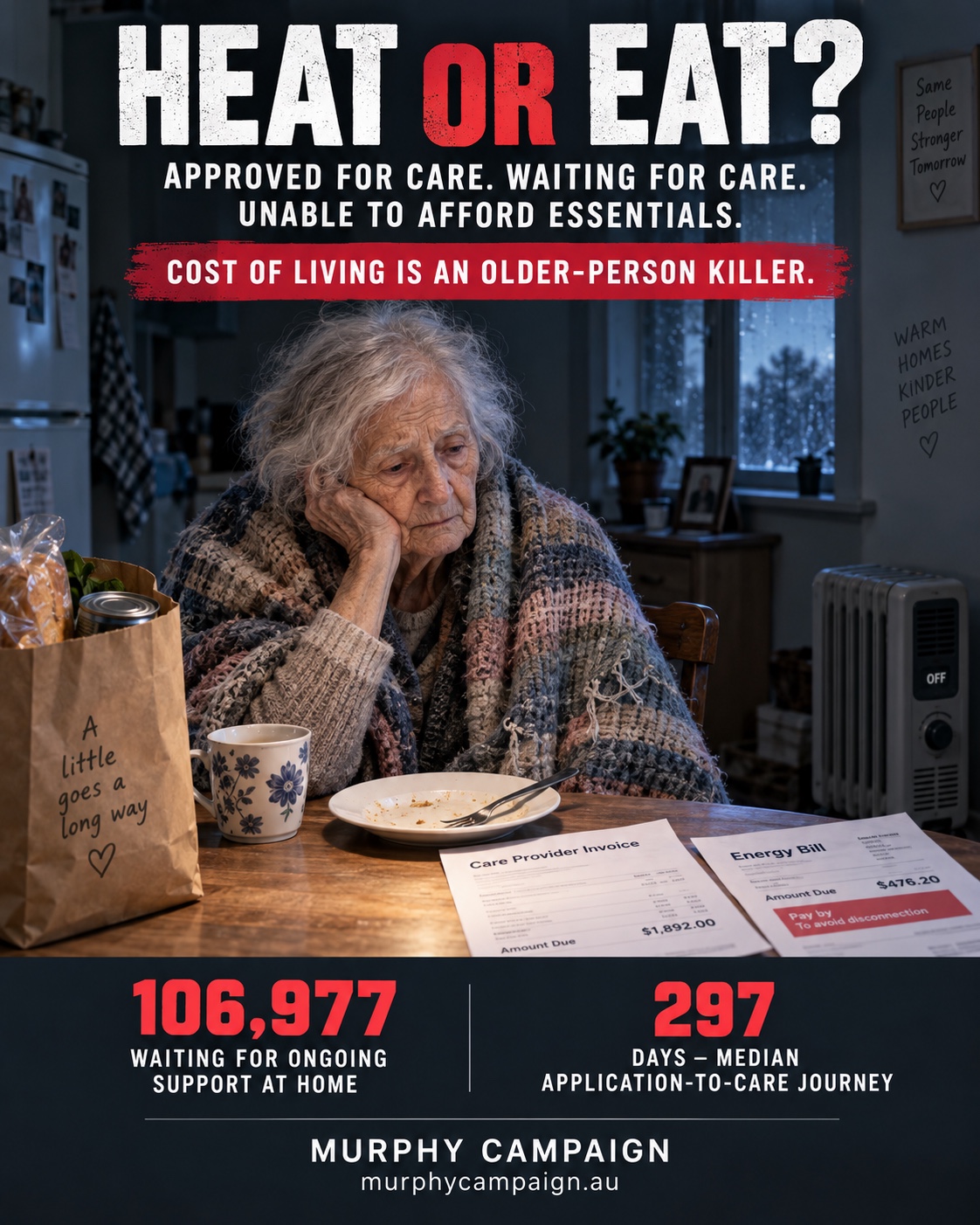
Heat or Eat poster contrasting an older Australian's hardship with government spending

FINANCIAL BURDEN SHIFTING

Heat or Eat?

Sheila's experience shows what delay means at the kitchen table. When approved care is not funded or delivered promptly, government costs do not disappear—they are transferred to older people and their families through food cuts, reduced heating, private purchases and unpaid care.

Sheila can no longer afford the food deliveries previously arranged through her care package. That is not a technical inconvenience. It is a direct human consequence of delay and inadequate support.

Cost of living is an older-person killer. Approved care must become delivered care.

Heat or Eat campaign evidence poster showing an older Australian unable to afford essential food, care and energy costs
The Waiting Care Scoreboard must measure the full journey—from application and assessment to funding allocation and the day care actually begins.

Latest campaign updates

The evidence keeps moving. So must government.

New evidence added 8–11 September 2026. Verified facts are separated from campaign demands and personal case evidence.

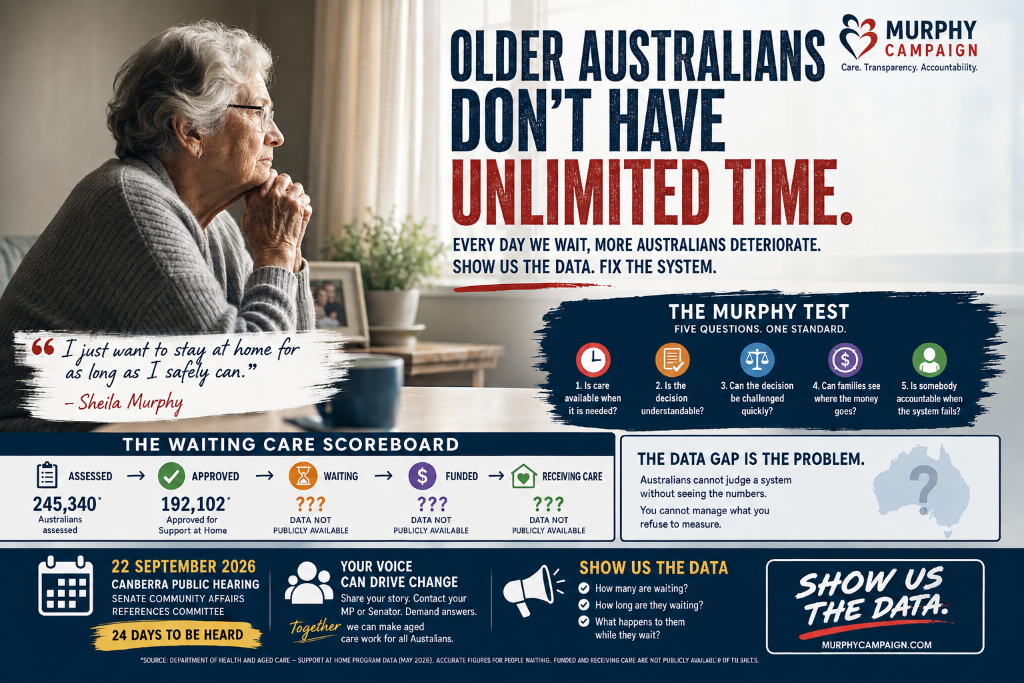
Murphy Campaign waiting-care scoreboard: older Australians do not have unlimited time

11 September 2026

Humans First: Care Now

Older Australians are not classifications, budget lines or places in a queue. The Murphy Campaign calls for immediate care at the assessed level, enforceable maximum waiting times, funded interim support when those limits are breached, transparent automated assessment, and meaningful human clinical review.

Approval is not access. Funding allocation is not delivered care. Measure the day care arrives.

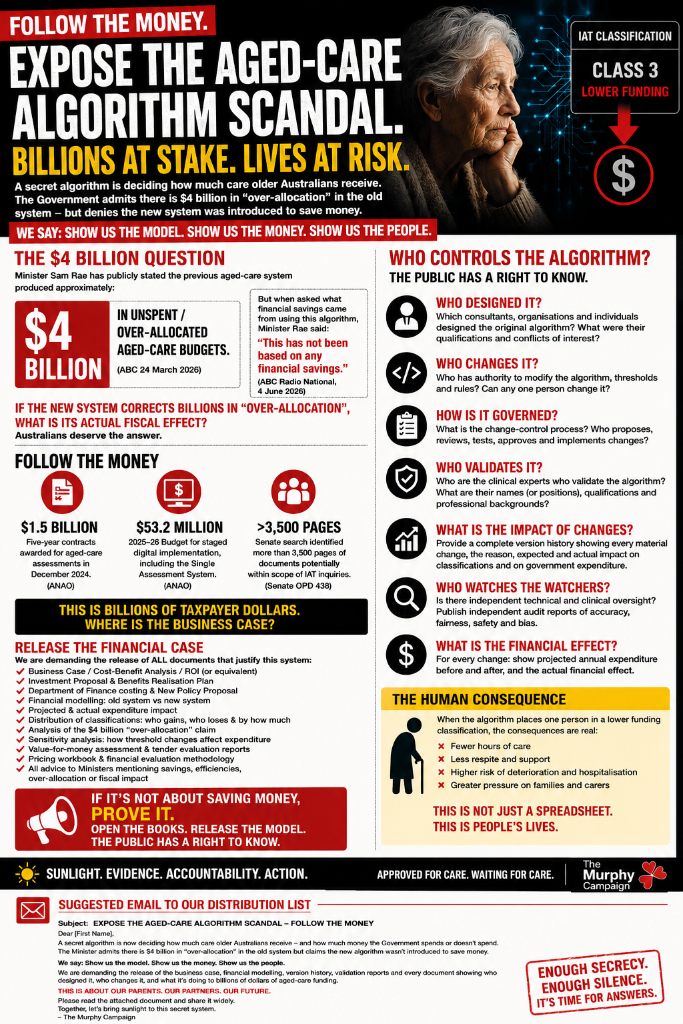
Aged-care algorithm accountability infographic: follow the money and expose the system

10 September 2026

They Knew Within Days

Freedom-of-information material indicates health authorities were identifying unexpected Integrated Assessment Tool outcomes soon after the new system began. The campaign is demanding publication of the algorithm's design, clinical validation, version history, human-override rules and financial consequences.

Public consequences cannot be governed by private arithmetic. Open the books.

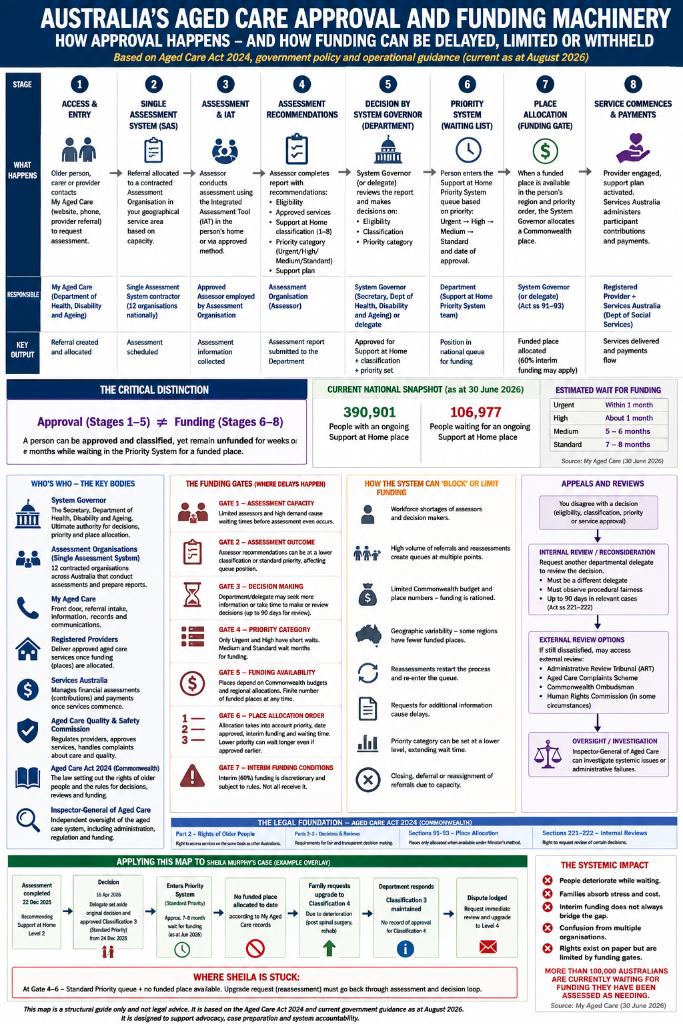
Australia's aged-care approval and funding machinery showing where Sheila Murphy's care is delayed

9 September 2026

Heat or Eat: How a Broken System Makes Families Pay

Sheila Murphy can no longer afford the food deliveries arranged under her care package. Delay and unaffordable contributions shift public failure onto pensioners and families through reduced essentials, private purchases, unpaid care, hospitalisation and premature residential care.

No older Australian approved for care should be left choosing between food and warmth.

Evidence update — 9–10 September 2026

Money retained. People waiting. Accountability passed elsewhere.

  • At 30 June 2026, 1,063 older people in NSW were medically ready for discharge but remained in hospital awaiting Commonwealth-funded aged-care support—up from 761 a year earlier.
  • The Department's 8 September financial snapshot identified about $4.0 billion in unspent Home Care Package balances. Those balances belong to existing participants; they are not a free pool for redistribution.
  • The Aged Care Quality and Safety Commission opened Case CN-202609-1115 and referred the campaign's system-wide concerns to the Office of the Inspector-General of Aged Care.
  • Rebecca Vassarotti MLA agreed that 106,977 people waiting after assessment is far too many and committed to raise the issue in an ACT Legislative Assembly budget speech.
  • Senator David Pocock's office advised that he is pursuing waiting times, adequate funding, IAT under-assessment, human override, transparency and accountability.

Government has shown it can change course when a model does not work. Now change course for the people still waiting for care.

Mattress Madness

When essential care becomes an obstacle course.

ℹ️

This is a documented case study of delay, duplicated administration and a clinically contradictory quote — prepared 4 September 2026. It is an individual experience presented separately from national statistics. See Evidence & Sources for the distinction.

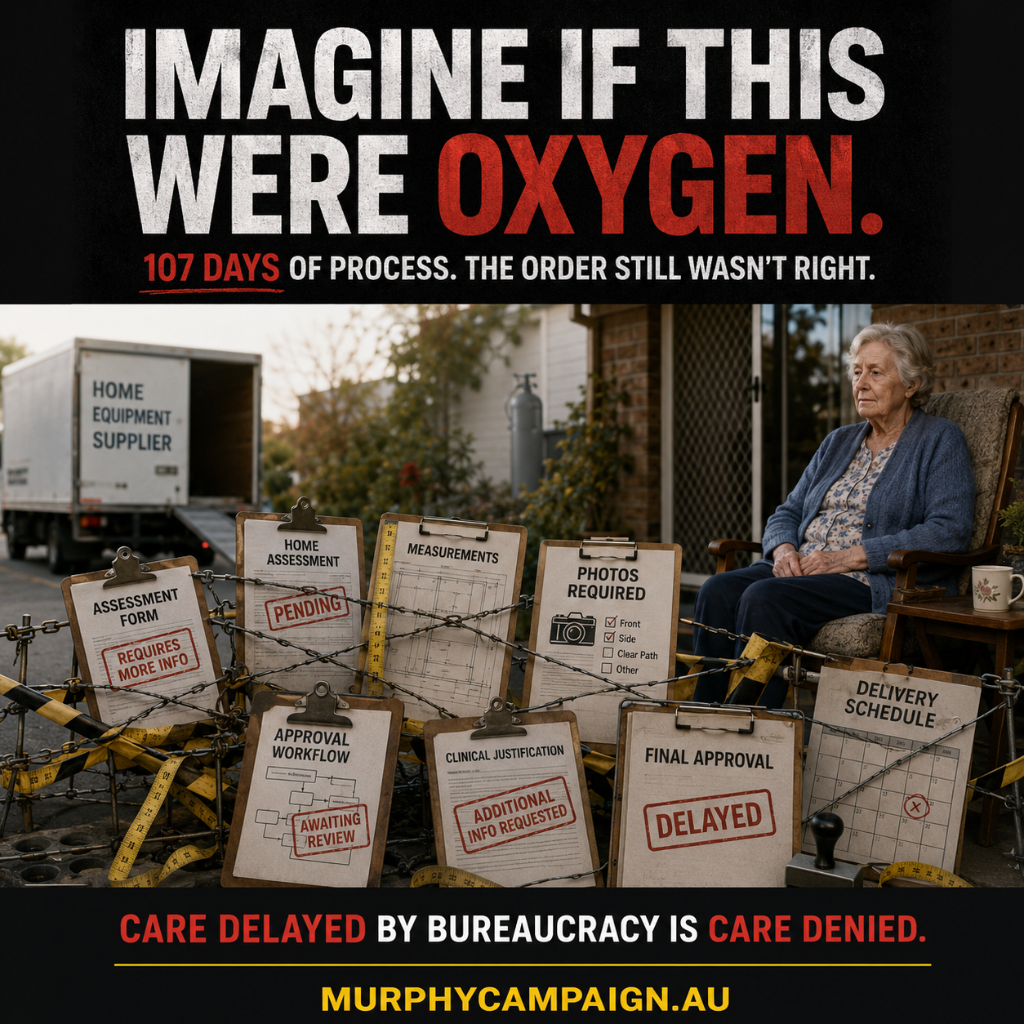
Imagine if this were oxygen. 107 days of process. The order still wasn't right. An elderly woman waits outside her home surrounded by clipboards showing assessment, approval and delivery forms wrapped in warning tape, beside a home equipment supplier truck. Care delayed by bureaucracy is care denied.

Executive brief

This is not a complaint about a mattress shop asking whether delivery is possible. It is a case study in what happens when an older person is made to carry the administrative burden of a fragmented care system.

Sheila, 85, has chronic back pain, arthritis and polymyalgia. A mattress was recommended following occupational-therapy assessment. By 4 September, the pathway had involved two home visits, a supplier trial, multiple reports, a quote, a late delivery questionnaire and no confirmed correct order.

107 days

from the first home assessment to 4 September — and the quote still specified the clinically unsuitable mattress. A further 4–6 week wait would extend the total to approximately 135–149 days.

What went wrong

“How can a system assess the person, inspect the home, supervise the trial — and still fail to place the right order?”

Documented timeline

20 May

First OT Home Assessment

Sheila's bedroom, standard bed, access, circulation space and home environment were inspected and recorded.

19 June

Further Meeting Requested

Advice received that the OT had been asked to arrange a further meeting.

21 July

Second OT Assessment

A mattress trial was recommended because of chronic back pain, arthritis and polymyalgia.

29 July

Report Received

The care provider received the report and advised that another OT appointment would be arranged.

13 August

Trial & Contradictory Quote Issued

Sheila attended Back to Sleep with OT Jason Szeto and trialled three mattresses. The medium Activ+ Comfort Classic was selected — yet Back to Sleep issued quote 26-00013132 for the clinically unsuitable firm version.

Documented Fact
25 August

Trial Report Supplied

The August trial report was supplied as supporting evidence.

3 September

Quote Forwarded — Three Weeks Late

Three weeks after the trial, the quote and supplier delivery form were forwarded to Sheila.

4 September

Still Unconfirmed

The order was described as expected to be confirmed, but the lead time could not yet be explained because the supplier's response was still awaited.

Campaign Position

What was recommended vs. what was quoted

OT Recommendation

Activ+ Comfort Classic — MEDIUM
Selected after supervised trial.

Supplier Quote

Activ+ Comfort Classic — FIRM
Quote 26-00013132; total $1,893.

The critical procurement error

Required safeguard: the firm-mattress quote should not be confirmed or paid. A corrected quote for the medium mattress is required, together with confirmation of stock and the earliest delivery date.

When delivery administration overwhelms care

The supplier form requested: photographs or video of the route from the street to the bedroom; measurements or a floor plan; doorway, hallway and corner dimensions; truck access; lift, stair and ceiling details; photographs of furniture requiring removal; and acceptance of additional charges and failed-delivery risks.

Some access questions are reasonable. A supplier must deliver equipment safely. The concern is proportionality and timing. The form appears designed for large powered beds and complex equipment, while this purchase is a queen mattress. It was also requested only after two home inspections had already documented the property and bedroom.

Information already documented

Who should carry the coordination burden?

The Support at Home Program Manual describes care management as including the identification of funding, confirmation of needs and goals, referrals, communication with professionals, and coordination of suppliers, quotes and delivery. On that basis, the provider should coordinate the process and reuse information already gathered — not drip-feed new administrative tasks to the older person.

A mattress is not an oxygen concentrator — but the administrative lesson is the same.

If the item were oxygen, a ventilator or another life-sustaining device, nobody would accept months of hand-offs, repeated assessment, a late access form and an order for the clinically unsuitable specification. Equipment that protects comfort, mobility, sleep and independence also requires urgency, accuracy and clear ownership.

Immediate action required

The care provider should now be required to complete the following actions without further avoidable delay:

1

Halt any order based on the incorrect firm-mattress quote.

2

Obtain a corrected written quote for the medium Activ+ Comfort Classic mattress.

3

Explain how the firm specification was selected despite the OT's contrary finding.

4

Confirm whether the medium queen mattress is in stock and provide the earliest firm delivery date.

5

Extract all available access information from the existing OT reports.

6

Arrange for the provider or OT — not Sheila — to obtain any genuinely missing measurements or photographs.

7

Ask the supplier to remove or waive form requirements that are irrelevant to a mattress-only delivery.

8

Seek expedited delivery in recognition of the time already elapsed.

9

Provide a written chronology identifying responsibility for each delay and period of inactivity.

The broader lesson

This case is about more than one mattress. It demonstrates how fragmentation turns care into process: one organisation assesses, another trials, another quotes, another approves, and the older person is left to connect the pieces.

“Approval should mean care — not another queue.”

FOLLOW THE MONEY. MEASURE THE OUTCOMES. PUT PEOPLE FIRST.

Evidence note

This brief is based on the supplied OT home-assessment and equipment-trial material, Back to Sleep quote 26-00013132, the supplier delivery form, and correspondence through 4 September 2026. References to provider responsibilities reflect the Support at Home Program Manual and strengthened Aged Care Quality Standards identified in the source material. Dates, quotations and clinical findings should be checked against the original records before external publication or formal complaint.

Download Full Brief (.docx) Download Campaign Graphic Share Your Experience
Dear Minister

An Open Letter

Approved for Care. Waiting for Care.

Older Australians are being assessed and approved for Support at Home — yet still waiting months for care to actually arrive.

106,977 waiting at approved level 297-day median to ongoing care 22 September Senate hearing
Follow The Money

Who Watches the Watchers?

A secret algorithm is deciding how much care older Australians receive. Billions of taxpayer dollars are at stake. We say: show us the model, show us the money, show us the people.

Read the Evidence Co-sign the Murphy Campaign
Expose the aged-care algorithm scandal infographic. The Government states $4 billion in unspent or over-allocated aged-care budgets under the old system, but Minister Sam Rae stated the new algorithm was not introduced based on any financial savings. Follow the money: $1.5 billion in five-year contracts awarded for aged-care assessments, $53.2 million 2025-26 budget for staged digital implementation, and more than 3,500 pages potentially within scope of a Senate order for production. Questions include who designed the algorithm, who can change it, how it is governed, who validates it, what is the impact of changes, and who watches the watchers. Human consequence of a lower funding classification: fewer hours of care, less respite and support, higher risk of deterioration and hospitalisation, greater pressure on families and carers.

If the Department participates in designing or refining the system, administers the assessment architecture, funds the resulting care and oversees reviews, independent scrutiny becomes critical.

The Murphy Campaign therefore calls for an independent technical, clinical and financial audit of the IAT classification algorithm.

That audit should examine:

• Clinical validity

• Classification accuracy

• Threshold effects

• Frailty

• Cognition and dementia

• Mental health

• Rapid deterioration

• Carer availability and carer collapse

• False-low classifications

• False-high classifications

• Review and reversal patterns

• Clinical judgement vs. algorithmic outcomes

• Demographic disparities

• Financial consequences of classification boundaries

The findings should be public.

More than 3,500 pages

Parliament has already pursued documentation concerning the IAT.

A preliminary search associated with a Senate order for production reportedly identified more than 3,500 pages potentially within scope.

That tells Australians something important:

There is an extensive documentary history behind this system.

We want the financial and governance components of that history brought into the sunlight.

This is about real people

An algorithm does not experience the consequences of getting a decision wrong.

Older Australians do.

Their husbands and wives do.

Their daughters and sons do.

Their carers do.

When an older Australian receives insufficient support, the consequences can include fewer hours of assistance, additional pressure on carers and families, and greater difficulty remaining safely and independently at home.

That is why this cannot become an argument conducted entirely between programmers, consultants and bureaucrats.

THE PERSON MUST REMAIN AT THE CENTRE OF THE DECISION.

The Murphy Campaign Demands

SHOW US THE BUSINESS CASE.
SHOW US THE FINANCIAL MODEL.
SHOW US HOW THE $4 BILLION FIGURE WAS CALCULATED.
SHOW US THE ALGORITHM GOVERNANCE FRAMEWORK.
SHOW US WHO DESIGNED IT.
SHOW US WHO CAN CHANGE IT.
SHOW US THEIR QUALIFICATIONS.
SHOW US THE VERSION HISTORY.
SHOW US THE CLINICAL VALIDATION.
SHOW US THE CLASSIFICATION DATA.
SHOW US THE FINANCIAL EFFECT OF EVERY MATERIAL REFINEMENT.

And if the Government's position remains that this system was not based on financial savings:

OPEN THE BOOKS AND PROVE IT.

We are not asking Australians to accept a conspiracy theory.

We are asking government to release the evidence.

Because an algorithm influencing the care of older Australians should never operate with:

PUBLIC CONSEQUENCES AND PRIVATE ARITHMETIC.

Sunlight. Evidence. Accountability. Action.

The Murphy Campaign
Approved for Care. Waiting for Care.

Share this demand:

Share on X Share on LinkedIn Share on Facebook
Read the Evidence Co-sign the Murphy Campaign
New Demand

The Algorithm Must Answer to the Person

When an automated system influences an older Australian's care, Australians have a right to know how it works.

Read the Evidence Co-sign the Murphy Campaign
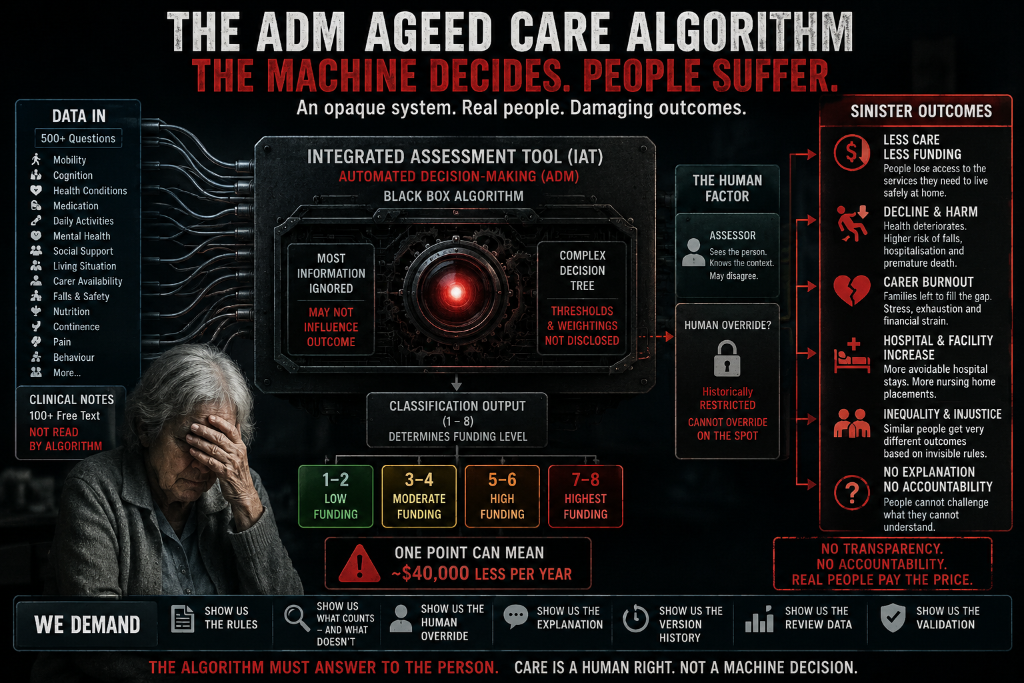
Diagram of the Integrated Assessment Tool showing over 500 questions and 100+ free-text clinical notes feeding into a black-box algorithm. Much of that information is not read by the algorithm. The classification output (1-8) determines funding level, with a one-point difference meaning up to $40,000 less per year. Historically, human override has been restricted. Sinister outcomes listed: less care and funding, decline and harm, carer burnout, hospital and facility increase, inequality and injustice, no explanation and no accountability.

The Murphy Campaign is putting a new question to the Australian Government:

Who actually decides how much care an older Australian needs — the human assessor, or the algorithm?

Australia's aged-care assessment system uses the Integrated Assessment Tool and algorithm-supported classification to help determine Support at Home classifications.

Technology itself is not the enemy. Used properly, technology can improve consistency, speed and access.

But when an automated decision-making system materially influences the care available to an older Australian, secrecy, weak explainability and restricted human intervention become matters of public accountability.

Recent public reporting and expert analysis have raised disturbing questions about the system.

The Integrated Assessment Tool collects hundreds of pieces of information about an older person. Yet expert analysis reported by ABC Four Corners found that much of the information collected does not feed into the classification algorithm.

Assessors can also record extensive free-text information describing the human being sitting in front of them — their circumstances, risks and needs — yet that material is not necessarily read by the algorithm producing the classification.

That leads to an extraordinary question:

Why collect information about a human being if it cannot materially influence the machine assessing their level of support?

A single point can mean $40,000 a year

Professor Kathy Eagar's analysis reported that factors including cognition, frailty and mental health can enter the decision tree relatively late. At one point in that decision process, a difference of a single point can reportedly correspond with a difference approaching $40,000 a year in available funding.

Think about what that means.

Two older Australians can have complex and broadly similar lives, yet a seemingly small difference at a decision boundary may contribute to dramatically different funding outcomes.

And historically, an assessor who knows the person, sees their circumstances and believes the resulting classification does not adequately reflect their needs has faced constraints on simply overriding that outcome on the spot.

That is where technology stops being merely an administrative tool and becomes a question of power and accountability.

A machine-made shortfall becomes a "Heat or Eat" choice

A funding gap on a spreadsheet is an abstraction. A funding gap in an 85-year-old's fortnightly budget is not.

When an opaque, algorithm-driven classification under-funds an older Australian's actual level of need, that shortfall does not disappear. It is absorbed — by the person, by their family, or by their health.

It is absorbed by a pensioner turning off the heater on a cold night because home care hours were classified too low to cover both warmth and groceries. It is absorbed by a family member paying out of pocket for support the system decided wasn't needed. It is absorbed by an older Australian skipping a meal, or skipping medication, to make the fortnight stretch.

This is the "Heat or Eat" travesty — and an unaccountable algorithm is helping to manufacture it.

Older Australians on fixed incomes already ration heating, food and medical care against the cost of living. A classification system that quietly under-counts a person's real needs — because a free-text clinical note wasn't read by the algorithm, or because cognition and frailty entered the decision tree too late — does not just produce a wrong number. It pushes a real person closer to that impossible choice between heating their home and feeding themselves properly.

No government should be able to say a classification was "validated" while the human consequence of getting it wrong is an older Australian going without heat, without food, or without care. That is not an edge case. It is the predictable result of a black-box system making high-stakes decisions about people who are already living on the margin.

The machine doesn't have to be evil to be dangerous

The danger is not a computer sitting somewhere maliciously deciding to hurt older Australians.

The danger is much more mundane — and potentially much more powerful.

Responsibility can disappear into the system.

The assessor can say: "The system produced the classification."

The Department can say: "The algorithm was validated."

Government can say: "You can request a review."

And the older Australian is left asking:

WHO ACTUALLY DECIDED HOW MUCH CARE I NEED?

That question must have an answer. A government should never be able to hide public responsibility behind technological complexity.

You cannot meaningfully challenge what you cannot understand

Review rights matter. But a person cannot effectively challenge a decision unless they can understand the material reasons the decision was made.

Which answers mattered? Which answers didn't? What threshold was crossed?

What evidence was disregarded by the automated process? Could the assessor intervene?

What version of the algorithm was used? Has that algorithm subsequently changed? How was it independently validated? How often are its classifications changed following human review?

These are not unreasonable demands. They are elementary requirements of accountable government.

SHOW US THE RULES.

The Murphy Campaign is calling for genuine sunlight over automated decision-making in aged care. We demand:

Show us the rules

Publish the classification methodology, relevant decision logic, variables and thresholds to the fullest extent lawfully possible.

Show us what counts — and what doesn't

Tell older Australians which information collected during their assessment materially influences classification and which information does not.

Show us the human override

There must be meaningful clinical escalation and human intervention when an algorithmic result fails to reflect the person standing in front of the assessor.

Show us the explanation

Every person affected should receive an intelligible explanation of the material factors that produced their classification.

Show us the version history

When the algorithm changes, disclose what changed, when it changed, why it changed and what validation occurred.

Show us the review data

Publish how frequently classifications are reviewed, changed or overturned and why.

Show us the validation

Permit genuine independent examination of whether the classification system is clinically sound, fair, explainable and sufficiently responsive to cognition, frailty, mental health, carer circumstances and other complex needs.

This is bigger than Sheila

The Murphy Campaign began with the lived experience of Sheila Murphy and one family's struggle through Australia's aged-care system. But Sheila's experience forces a much larger question.

Australia is building increasingly sophisticated systems to assess, classify and allocate public services. That may be inevitable. Unaccountable automated government is not.

If an algorithm influences whether an older Australian receives thousands of dollars more or less in support, Australians have a right to understand the basis of that outcome. If clinical information is collected but does not influence the classification, Australians deserve to know. If a human assessor cannot correct an outcome they believe is inappropriate, Australians deserve to know.

And if government believes its algorithm is fair, clinically valid and delivering better outcomes, then transparency should strengthen public confidence — not threaten it.

Put the algorithm in the sunlight.

The Senate Community Affairs References Committee is examining the Support at Home program, with its next public hearing scheduled for 22 September 2026 in Canberra. This is precisely the kind of question parliamentary scrutiny should examine.

The Murphy Campaign calls on Parliament, the Government, oversight agencies, aged-care advocates, clinicians, unions, researchers, journalists and older Australians themselves to demand answers.

Not rumours. Not conspiracy theories.

Evidence.

Because when government technology influences a person's care, the burden should never fall on an 85-year-old Australian to decipher the machine. The burden belongs to government to explain it.

THE ALGORITHM MUST ANSWER TO THE PERSON.

SHOW US THE RULES. · SHOW US WHAT COUNTS. · SHOW US THE HUMAN OVERRIDE.

SHOW US THE EXPLANATION. · SHOW US THE VERSION HISTORY. · SHOW US THE REVIEW DATA. · SHOW US THE VALIDATION.

Sunlight. Evidence. Accountability. Action.

Murphy Campaign
Approved for Care. Waiting for Care.

Share this demand:

Share on X Share on LinkedIn Share on Facebook
Read the Evidence Co-sign the Murphy Campaign

Sign the Open Letter

Every signature makes it harder for decision-makers to look away.

0 Be the first to sign the open letter

Help us reach the first 100 signatures.

Your co-signature will be recorded in the Murphy Campaign register, acknowledged by email, and included in campaign updates and formal delivery to ministers and parliamentarians. Your email will not be publicly displayed.

Thank you for adding your voice.

Now bring three Australians with you.

The numbers don't wait

106,977
People waiting for ongoing Support at Home funding at their approved level
As at 30 June 2026
297 days
Median from My Aged Care application to commencement of ongoing Support at Home
April-June 2026 quarter
22 Sep 2026
Next Senate hearing on the Support at Home Program
Canberra
See evidence and sources

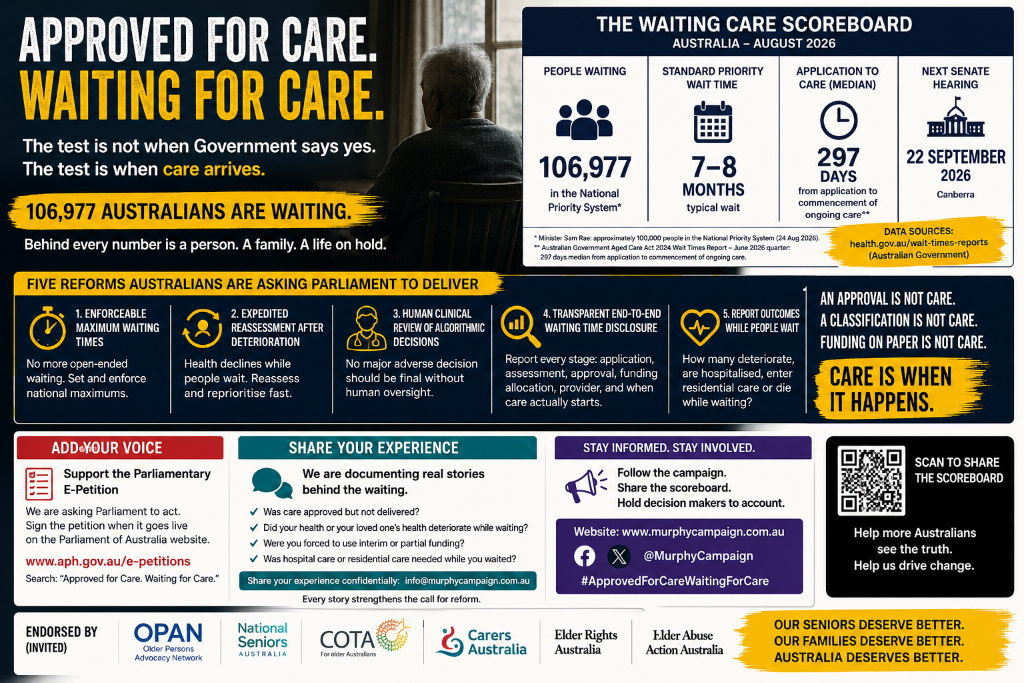
Five reforms Australians are asking Parliament to deliver

Enforceable maximum waiting times

No Australian should wait months for care they've been approved to receive.

Learn more

Expedited reassessment after deterioration

When health declines, reassessment must happen fast — not in 6-8 months.

Learn more

Human clinical review of algorithmic decisions

A classification tool should never override clinical judgement.

Learn more
📊

Transparent end-to-end waiting-time disclosure

Publish the numbers: who's waiting, how long, and what happens while they wait.

Learn more

Report outcomes while people wait

Hospitalisations, residential care entry, and deaths during waiting must be tracked and reported.

Learn more

These reforms are specific, measurable, and achievable.

Sign the Open Letter Share Your Experience

An Open Letter

Dear Minister,

We aren't asking for another promise.

We're asking for the numbers.

How many Australians are waiting?
How long are they waiting?
What happens to them while they wait?

Publish the data.

Dear Minister,

We aren't asking for another promise. We're asking for the numbers.

How many Australians are waiting for Support at Home services they have been assessed and approved for?

How long are they waiting — not on average, but at the 90th percentile? What is the longest wait?

What happens to them while they wait? How many are hospitalised? How many enter residential care? How many die?

What is the median time from My Aged Care application to commencement of ongoing Support at Home services, by Classification and priority category?

How many approved Australians have had their care needs change while waiting — and how many have been reassessed in a timely way?

We are not asking for reassurance. We are asking for data.

The test is not when Government says yes. The test is when care arrives.

Publish the data.

Were you approved for care — but still left waiting?

We are documenting real Australian experiences behind the numbers.

Was care approved but not delivered? Did health deteriorate while waiting? Were you forced onto interim or partial funding? Was hospital or residential care needed while waiting?

The Manifesto

They Expect Us to Give Up

Three battles. One system. Older Australians waiting for care. Experienced workers screened out because of age. An individual confronting a global technology corporation. The common strategy is delay, opacity and exhaustion. They expect us to give up. We will not.

Read the Evidence Co-sign the Murphy Campaign
An older woman waiting with a walking frame, an experienced professional facing an automated employment barrier, and a small-business operator confronting an imposing wall of digital systems beneath the words 'They Expect Us to Give Up.'

Today is the point of inflection

I have spent thousands of dollars on lawyers and invested hundreds of hours documenting evidence, writing correspondence, pursuing officials, challenging institutions and refusing to accept carefully worded acknowledgements as action.

At times, it has felt like screaming into the wind.

But today is not the day we surrender. Today is the point of inflection.

Three fights that once appeared separate have revealed the same underlying problem: powerful systems can delay, obscure and exhaust an individual until that person runs out of time, money, opportunity or strength.

They expect us to give up.

We will not.

Battlefield one: approved for aged care, still waiting for care

The Murphy Campaign began with Sheila Murphy, now 85. Following serious health events, spinal surgery and changing care needs, her family has spent months pursuing reassessment, appropriate support and the delivery of actual care.

Sheila's experience is personal. The failure is national.

At 30 June 2026, 106,977 older Australians were recorded as waiting for an ongoing Support at Home place.

Assessment is not care.

Approval is not care.

A classification is not care.

A place in a queue is not care.

Care begins when trained assistance actually arrives.

Older Australians do not experience waiting time as an administrative statistic. They experience another day without help showering, preparing food, moving safely, attending appointments or relieving an exhausted family carer.

At advanced age, six months is not an inconvenience. It is a significant part of somebody's remaining life.

Today's older Australians gave life to and raised the generations now governing this country. They worked, paid taxes, built institutions, cared for their own parents and created the communities and economy inherited by today's political leaders.

Without them, today's politicians would not be here—and they would not be in power.

Respect your parents. Honour the generation that raised you. Provide the care they need while they are still alive to receive it.

Battlefield two: Australia tells us to work longer—but will Australia hire us?

The second fight is age discrimination in recruitment.

Older Australians are told to remain productive, fund longer retirements and keep contributing. Yet experienced candidates repeatedly encounter recruitment processes that can reduce decades of achievement to appearance, assumptions about "energy" or "fit," and opaque automated screening.

The Show Us the Data campaign asks employers, recruiters and employment platforms to publish recruitment outcomes for candidates aged 55+, 60+ and 65+:

  • ■ Applied
  • ■ Shortlisted
  • ■ Interviewed
  • ■ Offered
  • ■ Hired

Without transparent outcomes, assurances about diversity are public relations—not evidence.

Australia tells us to work longer. But will Australia hire us?

We are not asking for guaranteed jobs. We are demanding a fair opportunity to compete and the data needed to determine whether older candidates are being systematically excluded.

Battlefield three: the individual versus the corporate technology provider

The third fight concerns my dispute with a corporate technology provider.

I allege that platform, billing and access failures caused serious disruption, financial loss and damage to my ability to conduct business. The corporate technology provider disputes the claim. The matter is subject to legal proceedings and the allegations have not been determined by a court.

That legal distinction matters. So does the imbalance confronting an individual who challenges a global technology business.

An individual must preserve every email, reconcile every transaction, document every interruption, fund legal advice and continue meeting deadlines while the corporation has established systems, lawyers and resources.

This campaign will not misrepresent disputed allegations as proven facts. It will insist that the evidence be examined, the disputed conduct be answered and accountability not be defeated by cost or exhaustion.

One struggle, two manifestations

These are not identical cases, and their evidence must remain separate. But they expose a common method of institutional power:

  1. Delay: Keep the person waiting until circumstances overtake them.
  2. Opacity: Make the process too complicated to understand or challenge.
  3. Fragmentation: Divide responsibility so nobody appears accountable.
  4. Economic pressure: Make resistance expensive enough to discourage it.
  5. Exhaustion: Rely on the person eventually stopping.

An older person waits for care.

An older worker waits for a fair opportunity.

In every case, the system benefits if the individual disappears quietly.

Strip away the forms, scripts, automated decisions and carefully managed acknowledgements, and the message received by too many older Australians is brutal:

"Just retire. Be quiet. Just die."

That is not our message. It is our indictment of a system that can treat an older person's remaining years, experience and dignity as expendable.

Our answer is equally direct:

"We will not retire from public life because you find our age inconvenient. We will not be quiet while people are denied care or opportunity. We will not disappear to make institutional failure easier to manage."

What we are demanding

For aged care

  • Enforceable maximum waiting times.
  • Immediate interim assistance when full care is delayed.
  • Monthly reporting by electorate, priority and classification.
  • Automatic reassessment after hospitalisation or serious deterioration.
  • Named accountability when approved care is not delivered.

For recruitment

  • Publication of outcomes for applicants aged 55+, 60+ and 65+.
  • Auditing of automated screening for age-related bias.
  • Capability-based assessment instead of appearance-based filtering.
  • Accountability from employers, recruiters and employment platforms.

This is the point of inflection

We are no longer asking merely to be noticed.

We are documenting what happens. We are naming the responsible institutions. We are asking measurable questions. We are recording who answers, who refuses and who remains silent.

This is not a campaign against care workers, honest recruiters, responsible businesses or public servants trying to help. It is a campaign against systems that conceal outcomes and treat exhaustion as resolution.

To every politician, regulator, employer, recruiter, journalist and advocate:

Do not send another generic acknowledgement.

Answer the evidence.

State what you will do.

Accept accountability for the outcome.

They expect us to give up.

They are wrong.

Stuart Le Gros
The Murphy Campaign | Show Us the Data

Share this manifesto:

Share on X Share on LinkedIn Share on Facebook
Read the Evidence Co-sign the Murphy Campaign
Publication safeguards

No implication is made that delay alone caused a particular death, injury or loss without case-specific evidence.

Every national statistic links to its primary source.

Personal medical information is limited to details Sheila has authorised for public campaigning.

Approved for Care. Waiting for Care. Add your voice.

Sign the Open Letter Share Your Experience

One Family's Experience of the Waiting Room

ℹ️

Sheila Murphy's case is an individual experience that illustrates the human cost of systemic delay. It is presented separately from national statistics and independent analysis elsewhere on this site. See Evidence & Sources for the distinction.

This is Sheila Murphy's timeline, told in chronological order. Where the family and government disagree, both positions are shown.

-- days

and counting since Sheila's Support at Home priority start date (24 December 2025)

Early 2025

Heart Attack

Sheila Murphy suffers a heart attack, prompting urgent review of her care needs.

2025

Reassessment Process Begins

A reassessment of Sheila's aged-care needs is initiated. The family waits for a determination.

~7 Months

Reassessment Delay

Approximately seven months pass during the reassessment process. During this time, Sheila's care needs increase. She undergoes spinal surgery and rehabilitation.

Documented Fact
Claim → Evidence
Claim: Sheila's reassessment took approximately seven months.
Evidence: Cross-reference of reassessment request correspondence and the 16 April 2026 determination letter (see Evidence Library). Underlying documents to be linked here once redaction is complete.
22 December 2025

Level 2 Assessment

An assessment determines Level 2 support. The family subsequently requests a higher level of support, citing Sheila's deteriorating health and increased care needs following surgery and rehabilitation.

March 2026

Spinal Surgery & Rehabilitation

Sheila undergoes spinal surgery and enters rehabilitation. Her care needs increase materially during this period.

Documented Fact
16 April 2026

Classification 3 Determined

The earlier Level 2 decision is set aside. A new determination assigns Support at Home Classification 3, standard priority, effective from 24 December 2025.

Documented Fact - Official decision
Claim → Evidence
Claim: Classification 3, standard priority, backdated to 24 December 2025.
Evidence: 16 April 2026 determination letter from the Department of Health and Aged Care (see Evidence Library → Assessment Decisions).
April 2026

Estimated 6-8 Month Wait

Government correspondence indicates an estimated 6-8 month wait at standard priority before Support at Home services commence.

Documented Fact - Government correspondence
Ongoing

Family Disputes Classification

The family disputes whether Classification 3 adequately reflects Sheila's needs, given her heart attack, spinal surgery, rehabilitation, and increased care requirements.

Disputed / Under Review
August 2026

Escalation & Campaign Launch

The matter is escalated to government ministers, regulators, parliamentarians, and advocacy organisations. The Murphy Campaign is launched to seek urgent resolution for Sheila and broader systemic reform.

Campaign Position

Where Family and Government Disagree

The campaign is committed to presenting both sides of any dispute. Below are the respective positions on the classification question.

Family's Position

The family contends that Classification 3 does not adequately reflect Sheila's care needs following a heart attack, spinal surgery, rehabilitation, and ongoing deterioration. They believe a higher classification is warranted based on her clinical history and current functional capacity.

Government's Position

The government's 16 April 2026 decision determined Classification 3 at standard priority, effective from 24 December 2025. This represents the official determination under the Support at Home program. The estimated wait time for services at this priority is 6-8 months.

Disputed / Under Review

Note: The family has requested an independent review of the classification decision. The outcome of that review is pending.

How Approval and Funding Actually Work

Approval is not the same as funding. This map shows every stage of Australia's aged-care approval and funding process — and exactly where Sheila's case is stuck.

Australia's Aged Care Approval and Funding Machinery: how approval happens and how funding can be delayed, limited or withheld, with an overlay showing where Sheila Murphy's case is stuck.

Source: My Aged Care (30 June 2026); Aged Care Act 2024. This map is a structural guide only, not legal advice.

Approved for Care. Waiting for Care. Add your voice.

Sign the Open Letter Share Your Experience

Australia, Show Us the Aged-Care Waiting List

The journey from needing care to receiving it should be transparent. This scoreboard tracks what we know - and what we don't.

The Waiting Care Scoreboard: 106,977 Australians waiting in the National Priority System, 7-8 months typical wait, 297 days median application to care, next Senate hearing 22 September 2026.

The Care Pipeline

Every older Australian who needs support at home passes through these stages. How many are at each one?

?
Assessed
?
Approved
?
Waiting
?
Funded
?
Receiving Care

The government has not published current figures for each stage of this pipeline. That absence is part of the problem.

What the Data Should Show

Metric Classification 1 Classification 2 Classification 3 Classification 4 Classification 5
People waiting Not published Not published Not published Not published Not published
Median wait time Not published Not published Not published Not published Not published
90th percentile wait Not published Not published Not published Not published Not published
Entered hospital while waiting Not published Not published Not published Not published Not published
Entered residential care while waiting Not published Not published Not published Not published Not published
Died while waiting Not published Not published Not published Not published Not published

By State and Territory

State/Territory People Waiting Median Wait (Days) Adverse Outcomes
NSWNot publishedNot publishedNot published
VictoriaNot publishedNot publishedNot published
QueenslandNot publishedNot publishedNot published
WANot publishedNot publishedNot published
SANot publishedNot publishedNot published
TasmaniaNot publishedNot publishedNot published
ACTNot publishedNot publishedNot published
NTNot publishedNot publishedNot published

Where data is not publicly available, we display that absence honestly. The fact that Australians cannot see how many people are waiting, for how long, or what happens to them while they wait is itself a campaign issue.

Approved for Care. Waiting for Care. Add your voice.

Sign the Open Letter Share Your Experience
?

How many older Australians deteriorate while waiting for care?

?

How many enter hospital while waiting?

?

How many die while waiting?

If government doesn't publish it, Australia cannot scrutinise it.

What We're Asking Government to Publish

Transparency is not a radical demand. You cannot manage what you refuse to measure - and Australians cannot judge the system without seeing the data.

The Questions

  1. How many older Australians are currently waiting for Support at Home services?
  2. How long have they been waiting?
  3. What level of care were they assessed as needing?
  4. How many deteriorated while waiting for care to commence?
  5. How many entered hospital while waiting?
  6. How many entered residential aged care because they could not wait any longer for home support?
  7. How many died before receiving their allocated support?
You cannot manage what you refuse to measure - and Australians cannot judge the system without seeing the data.

This is not a request for individual data. No one's personal health information needs to be exposed. We are asking for aggregate, de-identified reporting published regularly - monthly or quarterly - so that Parliament, journalists, advocates, and families can see whether the Support at Home program is meeting its purpose.

Campaign Position

We believe the following data sets should be published as a matter of routine:

Approved for Care. Waiting for Care. Add your voice.

Sign the Open Letter Share Your Experience

Documented. Sourced. Verifiable.

Source Classification

Every statistic in this campaign is classified by source type:

Government Figures

From official government sources: Department of Health, AIHW, Productivity Commission, ABS. These are the most authoritative but may understate the problem.

Independent Analysis

From independent bodies: Grattan Institute, Consumers Health Forum, COTA Australia, royal commission findings.

Media Reporting

From investigative journalism: ABC, The Age, SMH, Guardian Australia. Used where government data is absent.

Where government data is not published, we note its absence and call for its release. "Show us the data" is not just a slogan — it is a democratic demand.

Key Statistics with Primary Sources

Documented Fact

~250,000+ older Australians were waiting for home care support at the time of the Royal Commission.

Source: Royal Commission Final Report →
Documented Fact

Support at Home Program replaced Home Care Packages on 1 July 2025. Waiting list data for the new program has not been published.

Source: Dept. of Health →
Campaign Position

The Australian public does not know how many people are currently waiting for Support at Home care they have been assessed as needing. This data should be published monthly.

Campaign demand — data release
Documented Fact

Royal Commission found systemic neglect in Australian aged care, with thousands waiting 12+ months for approved care.

Source: Royal Commission →

Important: Individual Case vs National Claims

Sheila Murphy's experience is an individual case study. It illustrates the human impact of systemic delay, but it is not presented as statistical evidence of national trends. National statistics cited on this site come from government reports, royal commission findings, and independent analysis — not from Sheila's individual situation. This distinction is maintained throughout the campaign to preserve credibility.

Where we state a fact, we cite the source. Where we express an opinion or campaign position, we label it as such. This library is the foundation of our credibility. Source documents are being added as they are redacted for privacy.

Personal information is redacted unless Sheila Murphy has specifically consented to its publication. Documents are presented in good faith for the purpose of public interest accountability.

Government Documents

16 April 2026
Department of Health and Aged Care
Support at Home Classification 3 Determination
Official decision setting aside earlier Level 2 assessment and assigning Classification 3, standard priority, effective 24 December 2025.
Pending redaction →
2026
Department of Health and Aged Care
Estimated Wait Time Correspondence
Government correspondence indicating an estimated 6-8 month wait at standard priority for Support at Home services.
Pending redaction →

Assessment Decisions

22 December 2025
Regional Assessment Service
Level 2 Assessment
Initial assessment determining Level 2 support. Subsequently set aside by the 16 April 2026 determination.
Pending redaction →

Senate Inquiry Material

4 November 2025
Senate Community Affairs References Committee
Inquiry Referral
Senate referral of the Support at Home Program inquiry.
View source →

Parliamentary Correspondence

August 2026
Various Parliamentarians
Correspondence re: Sheila Murphy Case
Letters to government ministers and parliamentarians regarding Sheila's case and systemic aged-care concerns.
Pending redaction →

Aged Care Quality and Safety Commission

2026
Aged Care Quality and Safety Commission
Complaint / Quality Concern
Correspondence with the Commission regarding provider quality and service delivery.
Pending redaction →

Provider Correspondence

2025-2026
Aged Care Provider(s)
Service and Billing Correspondence
Correspondence regarding service delivery, billing, and charges. Some charges are disputed by the family.
Pending redaction →

Billing Evidence

2025-2026
Various
Invoices and Service Statements
Invoice and billing records. Some charges are disputed and under review. Redacted for privacy.
Pending redaction →

Research and Statistics

Ongoing
Various Government and Academic Sources
Aged Care Data and Reports
Published statistics, Aged Care Royal Commission findings, Productivity Commission reports, and academic research on aged-care wait times and outcomes.
Pending redaction →

Media Coverage

Pending
Various
Media Reports and Coverage
Media coverage of Sheila's case and the broader aged-care waiting-list issue. To be updated as coverage appears.
Pending redaction →

FOI Requests and Responses

2026
Department of Health and Aged Care
Freedom of Information Requests
FOI requests seeking aged-care waiting-list data and related departmental information. Responses will be published as received.
Pending redaction →

Approved for Care. Waiting for Care. Add your voice.

Sign the Open Letter Share Your Experience

The Campaign Record

Every letter, every email, every response — documented in full. Nothing is deleted when a politician leaves office or an email address changes. The original approach, delivery status, and any resend are all shown.

Status key: Sent Acknowledged Referred Response Received Action Promised Action Delivered No Response Delivery Failed - Resent

Date Sent Recipient Role / Office Subject Status Response / Notes
24 Dec 2025 Hon. Anika Wells Minister for Aged Care Initial complaint — Sheila Murphy's care deterioration, Support at Home Program delays Acknowledged Automated acknowledgement received. No substantive response to date.
Jan 2026 Wendy Askew Liberal Senator, Tasmania (aged care portfolio) Briefing on Sheila Murphy case + request for Senate inquiry support No Response No response received. Note: Wendy Askew has since left Parliament. Contact details updated; original approach preserved for the record.
Feb 2026 Department of Health & Aged Care Secretary's office Request for waiting list data — Support at Home Program Action Promised Department referred to publicly available quarterly reports. No bespoke data provided.
Mar 2026 ACCC Australian Competition & Consumer Commission Complaint re: aged-care billing practices and consumer protection Response Received Acknowledged complaint. Ref nos: REF4751488 / REF4754110. Assessment ongoing.
May 2026 Multiple MPs (cross-bench) Federal Parliament Campaign briefing — Murphy Test for aged-care reform Sent Sent to 15+ cross-bench MPs. Responses varied — some acknowledged, most no substantive reply.
Jun 2026 Senate Standing Committees Community Affairs Committee Submission for Senate inquiry into aged-care waiting times Acknowledged Submission acknowledged. Inquiry scheduled for September 2026.
Jul 2026 Hon. Mark Butler Minister for Health and Aged Care Escalation — 200+ days waiting, no care delivered Delivery Failed - Resent Initial email bounced (ministerial email change). Resent to updated address. Acknowledged but no substantive response.
Aug 2026 All Federal Senators Senate — upcoming inquiry Campaign launch briefing — Murphy Campaign website live Sent Distributed 29 August 2026. Responses pending.
Aug 2026 Journalists & Media ABC, The Age, SMH, Guardian Australia Media release — campaign launch + evidence pack Sent Distributed 29 August 2026. Coverage pending.

Preservation Policy

This campaign record is permanent. When a representative leaves office, their entry is updated with the new status (e.g. "Left Parliament — August 2026") but the original correspondence is never deleted. When an email bounces or fails, the failure is recorded alongside the resend. This ensures the historical record remains complete and accountable.

Approved for Care. Waiting for Care. Add your voice.

Sign the Open Letter Share Your Experience

The Action Tracker

Every approach to a public official is tracked through six stages. This makes institutional delay measurable — and visible.

11
Sent

Letters and emails sent to Ministers, MPs, regulators, and media.

4
Acknowledged

Automated or manual acknowledgement received. No substantive reply yet.

2
Referred

Matter referred to another department or agency.

1
Response Received

Substantive reply with content, not just acknowledgement.

1
Action Promised

Specific action committed (review, data release, inquiry referral).

0
Action Delivered

Promised action completed and verified. This is the target.

The Accountability Gap

11 approaches sent. 4 acknowledged. 2 referred. 1 substantive response. 1 action promised. 0 actions delivered.

This gap — between what was promised and what was delivered — is the measure of institutional delay. The tracker will be updated as responses arrive.

Support at Home Program Senate Inquiry

The Senate Community Affairs References Committee is examining the Support at Home Program. This is a critical opportunity for accountability.

Key Dates

4 November 2025 - Inquiry referred by the Senate

31 July 2026 - Submissions closed

24 November 2026 - Final report due

⚠ UPCOMING: 22 September 2026

Live countdown

Canberra Public Hearing - Senate Community Affairs References Committee

--
Days
--
Hours
--
Minutes
--
Seconds

This is a key opportunity for the Committee to question departmental officials directly about waiting-list data, reassessment delays, and adverse outcomes.

Issues Under Examination

What MurphyCampaign Wants the Senate to Ask

The following questions should be put to departmental officials and the Minister:

  1. How many people are currently waiting for Support at Home services, by Classification?
  2. What is the median and 90th-percentile waiting time for each Classification?
  3. How many people have been reassessed in the last 12 months, and what was the average reassessment processing time?
  4. How many people entered hospital while waiting for Support at Home services to commence?
  5. How many people entered residential aged care because they could not wait for home support?
  6. How many people died while waiting for their approved Support at Home services?
  7. What escalation mechanism exists for people whose condition deteriorates while waiting?
  8. How are adverse outcomes tracked, reported, and acted upon?
  9. What is the government doing to ensure provider pricing transparency for recipients and families?
  10. What individual accountability exists within the department for delays in reassessment?
  11. Why is waiting-list data not published routinely in aggregate, de-identified form?
  12. What steps are being taken to address thin markets where no providers are available?
  13. How does the Support at Home program interact with the hospital system when waiting patients require acute care?
  14. What complaints mechanism exists for families who dispute a Classification decision?
  15. How will the government measure the success of the Support at Home program over the next 12 months?
Campaign Position

These questions are not gotchas. They are the basic accountability questions that any publicly funded program should be able to answer.

Senate Hearing War Room

Before, during, and after 22 September 2026 — tracking what we asked, what was answered, and what happens next.

Before the hearing

The 15 questions above, submitted to the Committee ahead of 22 September.

During the hearing

Key statements and evidence will be logged here live as the hearing takes place.

After the hearing

Every question tracked to: Asked / Answered / Evaded / Action Promised — through to the 24 November 2026 final report.

Government Response Board

We asked → they answered → did they answer the question? Updated as responses are received. No responses have been logged yet.

QuestionResponse ReceivedAnswered?Correspondence
How many people are currently waiting, by Classification?No response yetTrack here
What is the median and 90th-percentile waiting time?No response yetTrack here
How many died while waiting for approved services?No response yetTrack here

Legend: 🟢 Yes   🟠 Partially   🔴 No. Rows will be added as each question is put to officials and a response is logged, with the original correspondence published alongside.

Sunlight is the Greatest Disinfectant

SUNLIGHT. EVIDENCE. ACCOUNTABILITY. ACTION.

Justice Louis Brandeis said sunlight is the greatest disinfectant. This campaign shines light on Australia's aged-care waiting list crisis — not with slogans, but with documented evidence, primary sources, and a public record of what was asked, who was asked, and what they actually did.

Every statistic cited here links to its primary source. Every claim is labelled: Documented Fact, Disputed / Under Review, or Campaign Position. Every letter sent to a Minister, MP, or regulator is recorded in our public Campaign Record below.

View the Campaign Record See the Action Tracker Evidence & Sources
Murphy Campaign poster: Older Australians don't have unlimited time. The Waiting Care Scoreboard, The Murphy Test, and Senate hearing countdown.

Source: Department of Health and Aged Care — Support at Home Program data. Figures sourced from the Department of Health and Aged Care Support at Home Program data, June 2026.

The Campaign Continues — And the Record Stays

The Murphy Campaign is maintaining a transparent record of our attempts to reach Australia's elected representatives about the aged-care crisis.

Some parliamentary email addresses used in our national distribution have changed or returned delivery failures. That does not mean those representatives, our attempts to contact them, or the correspondence will be erased from the campaign record.

Where an address has changed, we will identify the current official parliamentary contact and resend the correspondence.

Where an elected representative has left office, the historical record will remain. We will separately identify and contact their successor when that person takes office.

We do not rewrite history because an email address changes.

Every approach, acknowledgement, response, referral, bounce and failure to respond forms part of the public record of this campaign.

The question remains:

How long should older Australians wait for the care they have already been assessed as needing?

The Murphy Campaign will continue documenting the answers — and the silence.

murphycampaign.au

Sheila Murphy's story started as one family's fight for appropriate aged care. It has become a much bigger question.

How many Australians are waiting for care they have been assessed as needing — and what happens to them while they wait?

MurphyCampaign.au exists to document the evidence, demand transparency and advocate for an aged-care system in which support arrives when older Australians actually need it.

Campaign Position

Sheila is one person. She is not the only one.

Sheila Murphy's reassessment was delayed for approximately seven months. During that time, her care needs increased. She had a heart attack. She underwent spinal surgery. She spent months in rehabilitation. And still, the system asked her to wait.

This campaign begins with Sheila's experience, but it asks a question that belongs to every Australian: is the aged-care system working for everyone, or are people falling through the gaps while paperwork moves slowly?

The Support at Home program was designed to help older Australians remain in their own homes with dignity. But the distance between policy and lived experience can be vast. Reassessment delays, classification disputes, opaque billing, and a lack of transparent waiting-list data mean that families are left in the dark, navigating a system that asks them to trust it while providing little visibility into how it actually works.

The Numbers We Know

Sourced from the Australian Government Aged Care Act 2024 Wait Times Report, published June 2026

106,977
Australians waiting in the National Priority System
7-8 mo
Typical wait at standard priority
297
Median days, application to care commencing
?
Deaths, hospitalisations, residential entries while waiting
Data not publicly available

Every figure on this site is linked to its source. Where data is not publicly available, we say so.

SHOW US THE DATA.

🪑

Who is still waiting in this old chair?

Behind every waiting-list number is an older Australian whose time cannot be replaced.

The old, worn chair is the Murphy Campaign's recurring symbol — the same weathered chair, photographed in a hospital corridor, a kitchen, Parliament House, an empty family dining table, an aged-care waiting room.

What could you do in 250 days?

In that many days a baby changes enormously.
A government can pass legislation.
A hospital can treat thousands of patients.
A family can experience enormous change.

An older Australian can deteriorate dramatically.

Waiting isn't neutral.

Where Does the Aged-Care Dollar Actually Go?

Families are asked to trust the billing without being able to see where the money goes. This section examines specific concerns raised by Sheila Murphy's family and broader questions about aged-care pricing.

Disputed / Under Review

Occupational Therapy Charges: The family disputes charges associated with this service and has requested explanation and review. The family is not alleging fraud. The family is asking for transparency and an explanation of what was charged, by whom, and for what service.

No allegation of fraud is made on this site. Where charges are disputed, we present the evidence and state that the matter is under review. Any determination of wrongdoing must be made by an appropriate authority, not by a campaign website.

Specific Billing Concerns

Sheila's family has raised questions about:

Where documentary evidence supports a specific concern, it is published in the Evidence Library with appropriate redactions.

The Broader Question

Sheila's experience raises a question that applies to every recipient of aged-care funding:

What proportion of aged-care funding actually reaches the person receiving care, and what proportion is consumed by administration, management, and overhead?

Campaign Position

We believe every aged-care recipient and their family should receive simple, transaction-level statements showing exactly what was charged, by whom, for what service, and at what rate. This is standard in nearly every other consumer context. Aged care should be no different.

Five Questions for Every Aged-Care Policy

The Murphy Test is a simple accountability framework. Any aged-care policy, program, or decision should be able to answer these five questions. If the answer to any one is "no," the system hasn't passed the test.

1

Is care available when it is needed?

2

Is the decision understandable?

3

Can the decision be challenged quickly?

4

Can families see where the money goes?

5

Is somebody accountable when the system fails?

If the answer to any of these is No, the system hasn't passed The Murphy Test.

The Murphy Test is designed to be applied by anyone - families, journalists, parliamentarians, regulators - to any aged-care policy or program. It doesn't require expertise. It requires honesty.

Ten Specific Demands

"Fix aged care" is not a policy. These are specific, measurable, achievable reforms that would make the system more transparent and more accountable.

  1. Transparent national waiting-list reporting. Publish the number of people waiting for Support at Home services, by Classification, priority, and state/territory, monthly.
  2. Published median and 90th-percentile waiting times by Classification, so Australians know how long the longest waits actually are - not just the average.
  3. Rapid reassessment following major deterioration, surgery, or hospitalisation. A defined maximum timeframe for reassessment when a recipient's condition materially changes.
  4. A defined escalation mechanism for clinically urgent cases. No one should wait 6-8 months for care after spinal surgery.
  5. Transparent provider pricing and billing. Every provider should publish their rates and charges in a standardised format.
  6. Simple transaction-level statements for recipients and families, showing exactly what was charged, by whom, for what, and at what rate.
  7. Independent review of disputed classifications. A timely, accessible mechanism for families who believe a Classification does not reflect the recipient's needs.
  8. Reporting of adverse outcomes occurring while people await care: hospitalisations, residential care entry, and deaths.
  9. Parliamentary oversight of Support at Home implementation, including regular reporting to a parliamentary committee.
  10. Clear individual accountability within the responsible agencies. When the system fails someone, someone should be answerable.

An Open Letter

Add Your Voice Share Your Experience

Your co-signature adds weight to this campaign. Every name makes it harder for decision-makers to look away.

Dear Minister,

We aren't asking for another promise.

We're asking for the numbers.

How many Australians are waiting?
How long are they waiting?
What happens to them while they wait?

Publish the data.

0 Be the first to co-sign this letter

Your co-signature will be recorded in the Murphy Campaign signatory register, acknowledged by email, and batched for formal delivery to the responsible Minister, shadow minister, and relevant parliamentarians. Your email will not be shared with third parties.

What You Can Do

Change happens when enough people speak up. Here are practical, respectful actions you can take right now.

Pre-Written Correspondence

Respectful, customisable letter templates you can send to your MP, Senator, or the Senate Committee. Factual, non-partisan, and focused on accountability and transparency.

The Murphy Campaign Waiting Index

If you or someone you love is waiting for aged-care support, your experience matters. We are collecting anonymous data to build the first independent picture of Australia's aged-care waiting room.

Voluntary Anonymous Survey

Your privacy is paramount. This survey is anonymous. No names, email addresses, or identifying details are required. We collect only the information you choose to share, and it will be used solely to produce aggregate, de-identified statistics.

Consent: By submitting, you consent to the anonymised use of your experience in campaign reporting and the Murphy Campaign Waiting Index. You may withdraw your data at any time by contacting us.

Data retention: Raw responses are stored securely and retained for the duration of the campaign. Only aggregated, de-identified data is published.

Not a substitute for official channels: This survey does not replace official complaints to the Aged Care Quality and Safety Commission or your MP. It complements them.

What We're Collecting

Once the sample is sufficiently large, we will publish the Murphy Campaign Waiting Index - an independent, community-sourced picture of waiting times and outcomes across Australia. Full methodology and limitations will be published alongside the data.

Campaign Position

We believe community-sourced data is essential because the government has not published its own. This is not a scientific study - it is a transparency tool, and we will be honest about its limitations.

For Journalists

For Journalists, MPs & Advocates

This section provides everything needed to brief on the campaign: summary, chronology, evidence, and contacts.

Campaign Summary

Evidence-led advocacy for aged-care waiting list transparency. Founded on Sheila Murphy's 250+ day wait for approved care. Demands: publish waiting list data monthly, implement Support at Home Program properly, establish the Murphy Test for accountability.

Chronology

Dec 2025: Initial complaint to Minister Wells. Jan-Aug 2026: Escalation to MPs, regulators, Senate committees. Aug 2026: Public campaign launched. Sep 2026: Senate inquiry scheduled.

Evidence Available

Correspondence record, departmental responses, royal commission findings, AIHW reports, billing evidence, ACCC complaint references, AFCA case number.

Contact for Briefings

Stuart Le Gros, Murphy Campaign
Email: [email protected]
Website: murphycampaign.au

Everything a journalist needs to understand and report on the Murphy Campaign in one place.

One-Page Briefing

THE MURPHY CAMPAIGN

Australia's aged-care waiting room needs transparency. 106,977 Australians are currently waiting in the National Priority System. The typical wait at standard priority is 7-8 months. The median time from application to care commencing is 297 days.

Sheila Murphy waited approximately seven months for reassessment while her health deteriorated. The campaign asks: how many others are waiting, for how long, and what happens to them while they do? We demand transparent waiting-list reporting, rapid reassessment for deteriorating patients, and independent review of disputed classifications. The Senate Community Affairs References Committee is inquiring into the Support at Home Program. Public hearing: 22 September 2026, Canberra. Final report due: 24 November 2026.

Media Contact

This campaign has a destination.

Not "we embarrassed somebody." A specific, achievable outcome:

  • Sheila receives appropriate support.
  • Waiting-list information becomes transparent.
  • Urgent deterioration triggers rapid reassessment.
  • Families can understand every dollar charged.
  • Australians can see whether Support at Home is delivering what Parliament promised.

When these five things are true, MurphyCampaign will have done its job.

How We Label Information

Credibility is everything. This site uses three clear labels to distinguish between documented evidence, disputed claims, and campaign positions.

Documented Fact - Supported by a verifiable source, document, or official record
Disputed / Under Review - Contested between parties, or subject to an ongoing review or determination
Campaign Position - The opinion or demand of the Murphy Campaign, clearly marked as such

Our Standards

  • Every number is sourced. If we cite a figure, we link to where it came from.
  • No allegation of fraud or wrongdoing is made unless an authority has formally determined it.
  • Both sides of disputes are shown. Where the family and government disagree, both positions are presented.
  • Personal information is redacted unless Sheila Murphy has consented to its publication.
  • Opinions are labelled as opinions. Campaign positions are never presented as established fact.
  • Corrections are made promptly and transparently when errors are identified.

If you believe any information on this site is inaccurate, please contact [email protected] with the specific claim, the correct information, and supporting evidence. We will review and correct promptly.

Frequently Asked Questions

Is this campaign only about Sheila Murphy?

No. Sheila's case is the human story that illustrates a much bigger question — how many Australians assessed as needing aged care are still waiting, and what happens to them while they wait. The campaign uses her experience as evidence, not as its sole subject.

Is MurphyCampaign accusing anyone of fraud?

No. Where charges or decisions are disputed, we say so explicitly and label them "Disputed / Under Review." No allegation of fraud or wrongdoing is made unless determined by an appropriate authority.

Where do your statistics come from?

Every statistic on this site links to its original source — government reports, correspondence, or official determinations. Where data is not publicly available, we say so rather than guessing.

Is this campaign affiliated with a political party?

No. MurphyCampaign is non-partisan and does not endorse any political party or candidate.

How is my survey data used if I complete "Are You Waiting?"

Your response is anonymous — no name, email, or phone number is collected. Data is used only to produce aggregate, de-identified statistics for the Murphy Campaign Waiting Index, published with full methodology and limitations.

What is the Senate Inquiry and why does it matter?

The Senate Community Affairs References Committee is examining the Support at Home Program, including access, pricing, transitions, and thin markets. Its public hearing is 22 September 2026 in Canberra, with a final report due 24 November 2026. It's a direct opportunity to put accountability questions to government officials.

How can I get involved?

Visit the Take Action page — tell your story, contact your MP or Senator, make an FOI request, or complete the Are You Waiting? survey.

How do I request a correction?

Email [email protected] with the specific claim, the correct information, and supporting evidence.

SUNLIGHT. EVIDENCE. ACCOUNTABILITY. ACTION.

This campaign will not stop until waiting list data is published, accountability is enforced, and no older Australian is left waiting while their health deteriorates.

Add Your Voice View the Record

Four ways to make a difference

Sign the Open Letter

Add your name to the campaign for transparency and reform.

Sign Now

Share Your Experience

Tell us what happened while you or your loved one waited for care.

Share Your Story
📲

Share the Campaign

Bring three Australians with you. Every share reaches new eyes.

Share Now
🇻

Sign the Parliament e-Petition

Formal parliamentary pressure — coming soon. We'll let you know when it goes live.

Sign the Open Letter First

Every signature counts

Every name makes it harder for decision-makers to look away. Help us reach the next milestone.

1
100 signatures
First milestone
2
500 signatures
Growing movement
3
1,000 signatures
People power
4
5,000 signatures
National voice
5
10,000 signatures
Unignorable

0 of 10,000 signatures

While we fight for systemic reform, families still need to get their own affairs in order. When I'm Gone is a practical end-of-life planning tool built for Australians and New Zealanders - covering wills, superannuation, health directives, digital assets, funeral wishes, and legacy messages for loved ones.

Step-by-step plan Red Folder access Trusted people tiers PDF export Legacy vault AU & NZ focused
Start Your Plan
WIG

Your life. Your wishes.
Their peace of mind.

Sign the Open Letter