Approved for care. Funded at 60%. Left waiting for the rest.
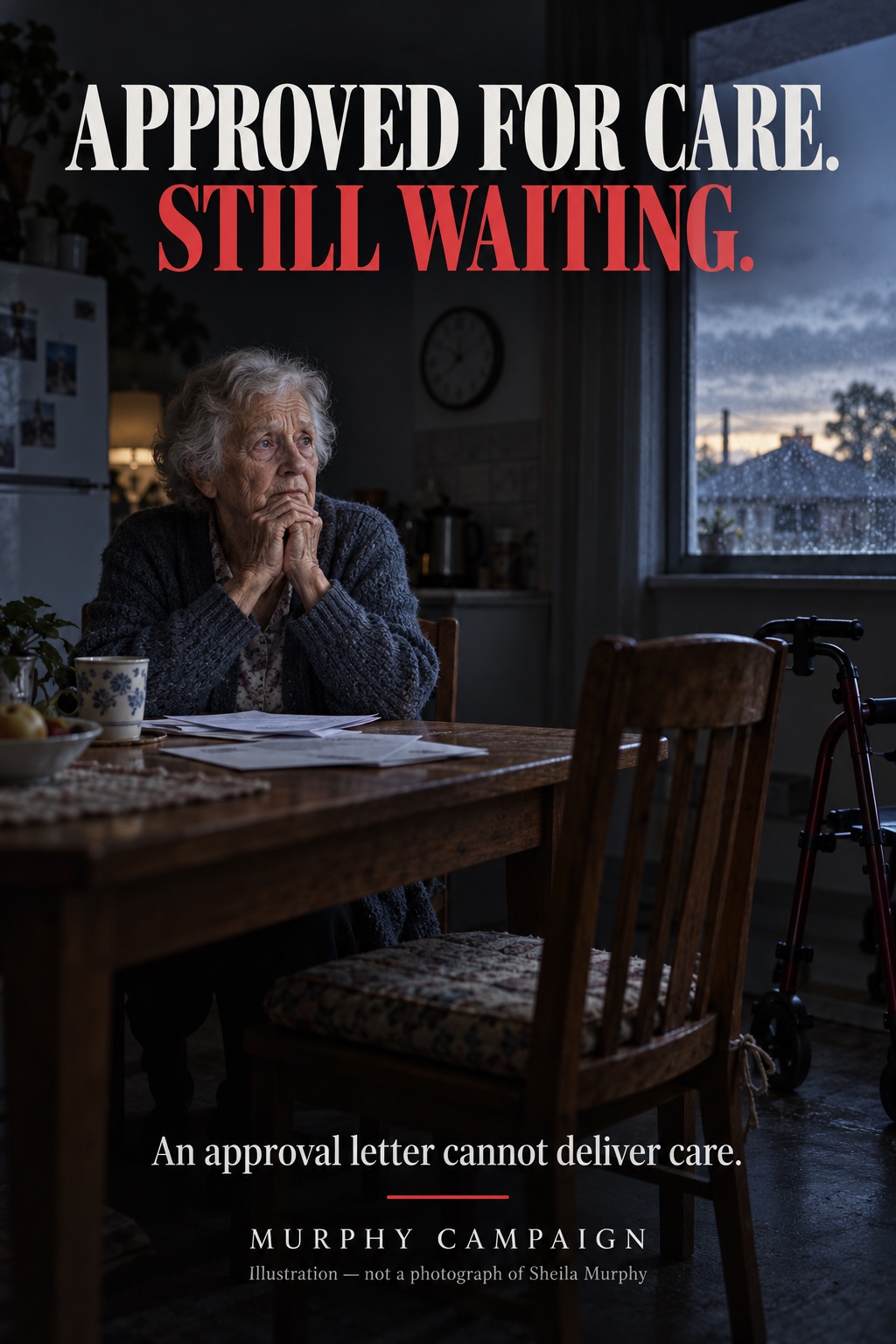
The aged-care algorithm scandal has exposed a failure of human oversight. But correcting the assessment is only half the battle. Government must answer for the gap between recognising an older person’s needs and releasing the funding to meet them.
An approval letter cannot help someone shower. A classification cannot deliver physiotherapy. A place in a queue cannot prevent a fall.
Yet Australian families are being asked to navigate an aged-care system in which assessed need, priority, funding allocation and actual care can remain separate milestones for months. Older people must live through every gap between them.
The Commonwealth Ombudsman’s report, Automation and oversight in Aged Care, released on 26 October, has given those families powerful grounds to demand answers. Reporting by Phoebe Loomes in The Senior, updated on 28 October, describes findings of unfairness, inconsistency, inadequate transparency and a legal framework that does not provide the professional override people were led to expect.
Those findings deserve national attention. So does another question: what happens when the system recognises a person’s funding classification, but initially makes only 60% available?
The second queue: waiting after approval
The Minimum Service Offer, or MSO, provides some participants with interim funding equivalent to 60% of their approved level while they wait for a Full Service Offer.
This is not an allegation that providers are withholding 40% of a payment they have received. It is a government allocation mechanism. Nor is it a claim that 40% of the entire aged-care budget has disappeared. The central issue is the difference between a person’s full classification amount and the interim amount assigned to them.
The government’s explanation must be presented fairly. In correspondence to me on 22 October, Finance said interim funding allows more people to begin critical services sooner rather than waiting entirely without a Full Service Offer. It described the mechanism as part of balancing demand and assessed needs within the program’s funding limits.
That explains the administrative intention. It does not establish that the resulting care plan is adequate for every person receiving it.
If an older person’s assessed needs require a particular level of support, the government must explain how a substantially smaller interim budget can meet those needs safely—and what happens when it cannot.
Getting some assistance sooner can be valuable. It cannot become a permanent excuse for leaving necessary assistance unavailable.
What 60% means in Sheila’s life
My mother-in-law, Sheila Murphy, is 85 and lives in Bentleigh. Our family’s experience is why I began the Murphy Campaign: Approved for Care. Waiting for Care.
Sheila has experienced serious health and mobility difficulties. Clinical evidence has been supplied to support her existing review, including physiotherapy evidence and a GP report dated 23 October. Her ongoing Support at Home Classification 5 and her High-to-Urgent priority reconsideration are separate matters. Neither an approved classification nor a request for review proves that full funding has been released.
The provider budget figures recorded in our correspondence show annual interim funding of $24,485.56. The published Classification 5 annual amount, current from 1 October, is $40,809.27. The arithmetic is stark: the former is 60% of the latter, rounded to cents.
| Annual-equivalent comparison | Amount |
|---|---|
| Published full Classification 5 funding | $40,809.27 |
| Interim funding recorded in the provider budget | $24,485.56 |
| Difference | $16,323.71 |
That is an annual-equivalent comparison, not a verified debt owed to Sheila or a statement of her current account balance. But it reveals the scale of the gap families must confront.
A provider report dated 1 October forecast $6,720.87 available for October–December against $6,661.16 expenditure: just $59.71 remaining. For January–March, it forecast $6,097.25 available against $7,056.44 expenditure, a $959.19 deficit. Those are dated forecasts, not today’s balance. Successive forecast closing deficits must not be added together as though they were independent losses.
Our correspondence records that weekly physiotherapy was confirmed and that the provider expected the potential January–March overspend to be avoided if full funding arrived within the anticipated upgrade period. We have asked for a funded continuity plan if that expectation proves wrong.
A family cannot build a safe care plan on the word “if”.
At the quoted rate of $235, thirteen weekly physiotherapy appointments would cost $3,055. That calculation does not establish overcharging. It demonstrates why an understandable ledger, agreed prices, committed services and a realistic funding forecast matter. A zero personal contribution does not mean a service consumes none of the participant’s allocated care budget.
A reviewer must answer the person, not merely acknowledge the file
Following the Ombudsman’s findings, I asked the Department to explain Sheila’s actual priority inputs, the preliminary four-point High result, the treatment of the clinical evidence and the human review pathway available now. I also asked for an accountable reviewer, an expected decision date and a separate explanation of funding and immediate support. The request was sent on 30 October to the existing review channel.
The Ombudsman’s report does not automatically overturn Sheila’s priority decision, grant Urgent status or release full funding. It strengthens the demand for a reasoned, individual response.
We are not asking for a computer result to be replaced by an unsupported preference. We are asking whether the recorded facts are correct, whether the evidence has been considered, who can correct errors and who takes responsibility if the resulting support is unsafe.
Sheila now has a named Elder Rights Australia advocate, Frank Quosdorf. On 30 October, he confirmed that he would assist Sheila and me and had contacted Aunty Grace’s interim Care Partner, Janet Johnstone, about obtaining her current budget. A consent email has been sent. Acceptance of that consent and production of the requested budget remain separate steps.
Advocacy is progress. It is not a substitute for funding.
Deaths while waiting must not disappear into administrative categories
Older Australians dying while waiting for home-care funding is not a new concern. But a serious accountability system must go beyond a single headline waiting-list figure.
How many people die before any allocation? How many die after receiving interim funding but before full funding? How many deteriorate, enter hospital or move into residential care while their assessed needs remain only partly supported?
Those groups must be reported separately. Giving someone an interim allocation must not make their unresolved need invisible.
A death during a waiting period does not, by itself, prove that the delay caused it. That is precisely why government must publish linked outcomes and commission independent analysis of avoidable harm. An absence of causal evidence is not evidence that the system is safe.
No family should have to establish a national mortality pattern before receiving a practical answer about tomorrow’s essential care.
Follow the money—and the care
The Murphy Campaign has already sought the records behind the 60/40 mechanism, non-backdating, allocation controls and the journey from appropriation to delivered services. Our 16 September accountability pack put these questions on the record. This issue has been raised; it has not been adequately answered.
Finance’s 22 October response explained the demand-management rationale and disputed the premise that the unassigned 40% has a separate accounting location. That makes a careful reconciliation more important, not less. Parliament should require the actual figures rather than assume a segregated fund exists.
On 30 October, Services Australia confirmed that it received our focused FOI request on 2 October and was consulting the relevant business area. Its reply supplied no documents or dated completion plan. Consultation may be a necessary processing step. It is not disclosure.
The public needs a monthly account of how many people are assessed, approved, assigned interim funding, assigned full funding and actually receiving the services they need. Alongside those counts must sit the dollars, the time spent at each stage and the adverse outcomes.
Budget announcements are inputs. Delivered care is the test.
What government must do now
First, implement the Ombudsman’s recommendations with published owners, milestones and progress reports. Restore an effective lawful human decision pathway, explain the system clearly and examine the rules and governance that produced these failures.
Second, subject the 60% interim model to an independent adequacy and safety assessment. Publish the basis for choosing 60%, the alternatives considered, the evidence about unmet need and the safeguards when essential care cannot fit within the interim amount.
Third, require an individual continuity plan where interim funding will not sustain necessary services. Name the responsible officer and identify the available escalation or bridging response. Do not ask providers and families to rely on an unconfirmed future funding date.
Fourth, publish deaths, hospital admissions, residential-care entry and deterioration while people wait—separately for people with no allocation and those receiving interim funding. Explain what the data can and cannot establish.
Fifth, account openly for the funding difference and the consequences of non-backdating. A later allocation does not restore treatment that was missed, reverse deterioration or return time to a family.
Finally, answer individual cases individually. For Sheila, that means reasons, accurate inputs, consideration of the clinical evidence, a lawful review route and a usable, sustainable care budget.
The government cannot claim success simply because an assessment is completed or an allocation has been counted.
Care reform succeeds when an older person receives the care they need, in time for it to make a difference.
Approval is a promise on paper. Care must arrive while the person is still here to receive it.
Public sources and evidence
Commonwealth Ombudsman: Automation and oversight in Aged Care
My Aged Care: Support at Home costs and contributions
Murphy Campaign: funding accountability
Case figures and correspondence are drawn from family campaign records, as dated in the article. The Ombudsman report is discussed alongside reporting by Phoebe Loomes in The Senior, updated 28 October. No national death count is asserted. Private evidence links and underlying clinical records are excluded from this mailing.
Stuart Le Gros
Murphy Campaign
murphycampaign.au
Reply to request removal from future campaign mailings.